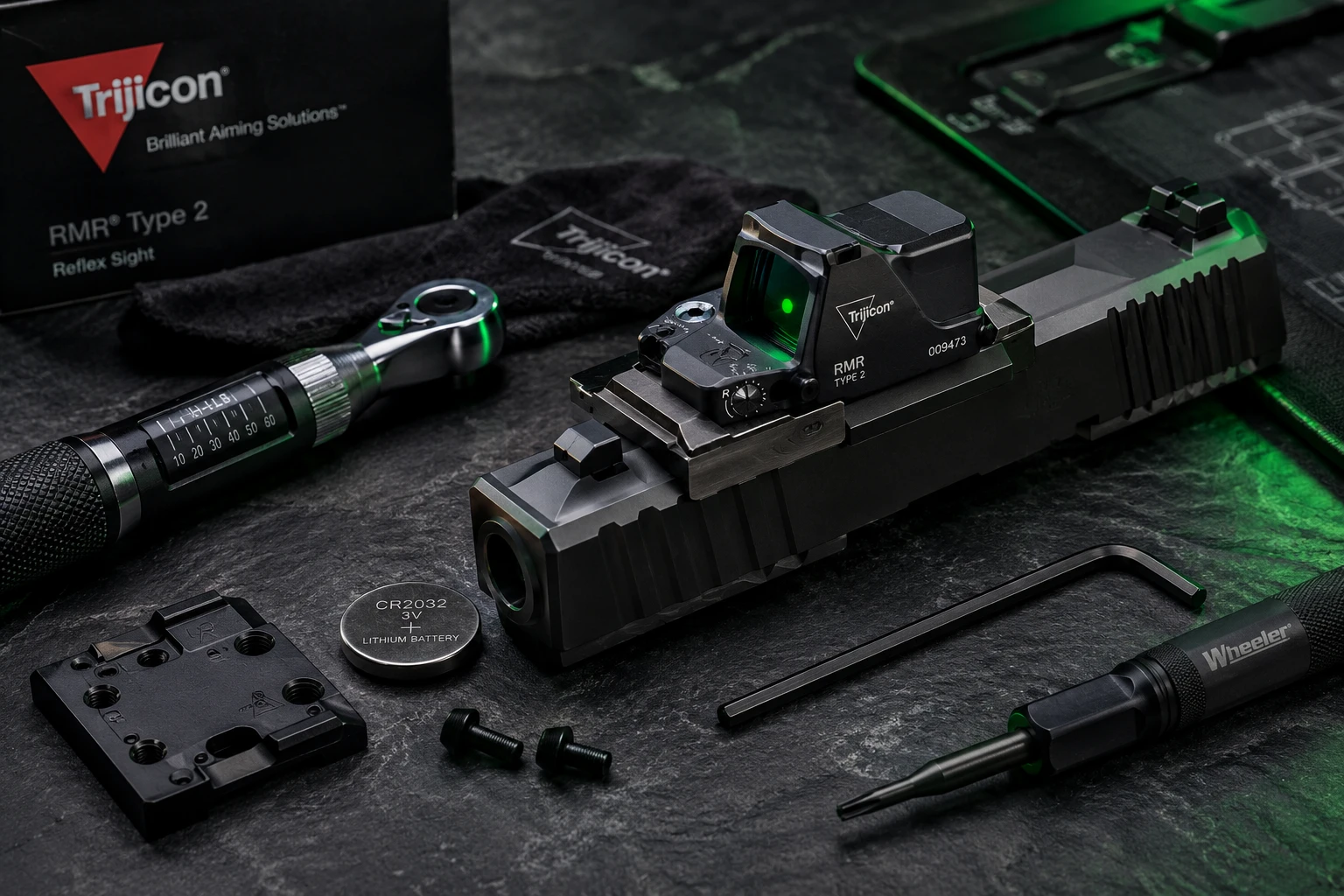
Trijicon RMR Type 2 Green Dot Review: RM06-C-700800
Sep 23rd 2026
The Trijicon RMR Type 2 Green Dot Sight (model RM06-C-700800) is an LED reflex optic with a 3.25 MOA green reticle designed for slide-mounted pistols and compact firearms. It represents a distinct variant of the broader RMR Type 2 family—specifically engineered with green illumination instead of the traditional red dot. This review examines the specifications, practical performance characteristics, battery considerations, and mounting requirements of this specific model.
The RMR Type 2 platform was selected by U.S. Special Operations Command (USSOCOM) for the Handgun Reflex Sight (HRS) Contract after extensive testing demonstrated its reliability under slide-cycle recoil and field conditions. The green-dot variant applies this same durability engineering to a different illumination wavelength, offering distinct optical advantages for certain shooters and lighting conditions.
What Is the Trijicon RMR Type 2 Green Dot (RM06-C-700800)?
The Trijicon RMR Type 2 Green Dot is a reflex sight—not a magnified optic. It operates on a single focal plane, meaning your eye doesn't need to focus on the reticle or the target separately; both appear clear at the same distance. This is why red dot (and green dot) sights are fast for close-quarters engagement and defensive shooting.
The specific model discussed here is the RM06-C-700800: an LED-powered RMR Type 2 with a green reticle, 3.25 MOA dot size, and adjustable brightness. It is not a battery-free or passive illumination design; it requires a CR2032 lithium battery for operation.
The RMR Type 2 is built for pistol use. It weighs only 1.2 ounces and measures 1.8 inches long, 1.1 inches wide, and 1 inch tall. The compact footprint fits on full-size slides (like a Glock 19 or Springfield Prodigy) without adding significant bulk or altering pistol handling. It also mounts on rifles and shotguns via appropriate RMR-compatible adapters, though it was optimized for handgun applications.
How Green Illumination Differs From Red: What the Research Shows
The human eye does not respond equally to all wavelengths of light. Research indicates that human vision is most sensitive to green light in the 530-534 nanometer wavelength range. This fundamental optical property means green illumination can appear brighter than red illumination at the same LED power output—a physiological fact, not a marketing claim.
What this means in practice:
- Daylight performance: Green reticles tend to maintain visibility in bright sunlight without the "solar flare" effect that red dots sometimes exhibit in high-glare conditions. This is not universal; individual results vary based on astigmatism, eye health, and personal sensitivity. But the principle is established: green wavelengths interact differently with bright light than red wavelengths do.
- Eye strain: Some users report that green illumination feels easier on the eyes during extended use compared to red. This is a subjective experience— some shooters perceive it this way, while others do not. The green-vs-red preference is genuinely personal.
- Astigmatism and color perception: People with astigmatism or red-green color blindness may perceive green reticles more crisply than red. Astigmatism causes the eye's lens to focus light unevenly, which can distort the appearance of a reticle. Some users with astigmatism report that a green dot appears sharper than an equivalent red dot. This is not true for everyone— individual vision varies significantly.
- Battery efficiency: Because green appears brighter at lower power levels, users can often run lower brightness settings than they would with a red dot, potentially extending battery runtime.
What's not true: Green illumination does not eliminate optical distortion, correct vision problems, or work equally well for all users in all conditions. The choice between green and red remains subjective. Some shooters prefer red for tradition, familiarity, or personal perception.
Understanding 3.25 MOA: Dot Size at Realistic Distances
MOA stands for Minute of Angle—an angular measurement equal to 1/60th of a degree. In practical terms, 1 MOA at 100 yards equals approximately 1 inch of target coverage.
A 3.25 MOA dot means the dot covers approximately 3.25 inches at 100 yards. At closer distances, the coverage is proportionally smaller:
| Distance | Approximate 3.25 MOA Coverage |
|---|---|
| 7 yards | ~0.24 inches |
| 10 yards | ~0.34 inches |
| 25 yards | ~0.85 inches |
| 50 yards | ~1.63 inches |
| 100 yards | ~3.25 inches |
Important clarification: The dot size does not inherently limit accuracy. A shooter with a skilled grip, proper sight alignment, and trigger control can shoot tighter groups than the dot itself suggests. The dot size affects how fast the sight is to acquire and how precisely you can place a single shot—not the absolute accuracy capability of the firearm.
At 7 yards, a 0.24-inch dot is small enough that you must aim deliberately for precision shots, yet large enough to find quickly. At 25 yards, the 0.85-inch dot remains precise for center-mass hits but encourages careful aim rather than aggressive speed. This balance is why 3.25 MOA is considered versatile for defensive, competitive, and training applications.
Comparing the RM06 Green to Other RMR Type 2 Configurations
The RMR Type 2 family includes multiple dot-size options. The green illumination is currently available only in the 3.25 MOA configuration (RM06-C-700800).
RM06 (3.25 MOA) — Green Illumination
This is the model under review. The 3.25 MOA dot offers a balanced compromise: fast enough to acquire for defensive shooting, precise enough for accurate placement at training distances.
RM07 (6.5 MOA) — Red Illumination Only
A larger dot optimized for speed and close-quarters engagement. The 6.5 MOA dot is roughly twice the size of the RM06, making it faster to find on the slide but less precise at distance. It comes in red illumination only; green is not available in this dot size. Shooters prioritizing rapid acquisition over precision often choose the RM07.
RM09 (1 MOA) — Red Illumination Only
A smaller, sharper dot for precision and longer-distance shooting. The 1 MOA dot requires more time to locate but enables precise aiming. Not typically chosen for defensive applications.
Other configurations:
Trijicon also makes dual-illuminated RMR variants (battery-free, using fiber optics and tritium) in 9 MOA sizes, and the RMRcc (a compact variant for micro-carry pistols). These are separate product lines from the adjustable-LED RM06 green.
Technical Specifications: Housing, Materials, and Durability
Housing and Construction
The RMR housing is forged from 7075-T6 aluminum—aircraft-grade material used in landing gear and structural components. This alloy provides an exceptional strength-to-weight ratio while remaining corrosion-resistant. The housing uses a patented concave shape on top that absorbs impacts and diverts stress away from the lens rather than concentrating force on the optic.
Optics
The sight uses multi-coated glass lenses to reduce glare and improve light transmission. The lens design provides unlimited eye relief, meaning you can position your head at any distance from the sight and still see the full sight picture.
Adjustment
Windage and elevation adjustments click in 1 MOA increments. Each click moves the impact point 1 inch at 100 yards. This precision allows for exact zeroing without waste. The adjusters use audible clicks and are easily turned by hand or a coin.
Waterproofing
The RMR Type 2 is rated waterproof to 20 meters (approximately 66 feet). This rating indicates the optic can withstand submersion and water pressure at that depth without internal flooding. In practical terms, the optic is suitable for water crossings, rain, and washdown—standard for tactical and field use.
Button Lock Function
The sight includes a button-lock mode that prevents accidental adjustments to brightness or mode settings. Once activated, the buttons remain non-functional until the lock is deliberately disengaged. This protects against unintended changes during carry or transport.
Specifications Summary
| Specification | Value |
|---|---|
| Model | RM06-C-700800 |
| Illumination | LED (Adjustable) |
| Reticle Color | Green (Day & Night) |
| Dot Size | 3.25 MOA |
| Brightness Settings | 8 (2 night vision compatible) |
| Magnification | 1x (no magnification) |
| Housing Material | Forged 7075-T6 Aluminum |
| Weight | 1.2 oz (with battery) |
| Length | 1.8 inches |
| Width | 1.1 inches |
| Height | 1 inch |
| Battery | 1x CR2032 Lithium |
| Waterproof Rating | 20 meters |
| Click Value | 1 MOA |
| Mounting Footprint | RMR (industry standard) |
Battery Life, Replacement, and Maintenance
Manufacturer Battery Specification
Trijicon rates the battery life as approximately 2 years of continuous operation at brightness setting 4 of 8, measured at standard room temperature (70°F/21°C). This is based on typical indoor/outdoor mixed use, not constant maximum brightness or extreme temperature conditions.
Actual battery life depends on:
- Brightness setting used: Lower settings (1-4) consume less power. Brightness 5-8 drains the battery faster.
- Operating mode: Automatic brightness adjustment enables the sight to scale power based on ambient light, often extending battery life in stable conditions. Manual fixed-brightness mode can drain faster if set high.
- Temperature: Cold temperatures reduce lithium battery performance. Hot temperatures may accelerate drain.
- Usage pattern: A sight left in auto mode at an indoor range may last longer than one used outdoors in varying light.
Battery Replacement
The CR2032 is a standard lithium coin battery available at most pharmacies, grocery stores, and gun shops for $2-5. Replacement requires:
- Remove the two Phillips-head screws on top of the RMR.
- Lift the battery door.
- Remove the old CR2032 and insert a new one.
- Replace the battery door and screws.
The process takes approximately 30 seconds. The sight does not require removal from the pistol to change the battery; you can do it while the optic is mounted.
Do not over-tighten the screws when reinstalling—hand-tight is sufficient and protects against cross-threading.
Practical Maintenance
Most shooters replace the battery once per year as routine preventive maintenance, rather than waiting for the sight to dim. This ensures you never experience a dead battery during training or competition. Keep a spare CR2032 in your range bag or pistol case.
No lubrication, alignment checks, or electronics service is required for normal operation.
Mounting on Glock MOS and Other Platforms
The RMR Type 2 uses the RMR footprint—an industry-standard mounting pattern now found on Glock MOS, Springfield OSP, and many modern optics-ready pistols.
Glock MOS Installation
Glock MOS (Modular Optic System) pistols have a pre-cut recess on the slide designed to accept optics using the RMR footprint. Installation requires:
- A Glock MOS sealing plate (required to prevent debris entry into the MOS recess).
- Trijicon RMR mounting screws (included with the RMR).
- A hex wrench (included with the RMR).
Important: Do not mount the RMR directly to the MOS recess without a sealing plate. The gap between the RMR base and the recess can allow moisture and debris to enter the pistol. Trijicon includes a sealing plate (AC32064) specifically for this purpose.
The sealing plate fits into the MOS recess, and the RMR sits on top of it. Torque specifications for the mounting screws should follow the manufacturer's guidance—check your Glock documentation or Trijicon's instructions for correct screw length and tightness. Do not guess at torque; incorrect tightness can cause zero shift or failure.
Non-MOS Glocks
Pre-MOS Glock models (Gen 1-3, Gen4 non-MOS) do not have a pre-cut optics recess. Options include:
- Slide milling: A qualified gunsmith can mill the slide to accept the RMR footprint. Cost typically ranges from $200-400. This is permanent.
- Third-party mount: Steel mounting systems attach to the slide without modifications. These are heavier and taller than direct mounts but enable RMR use on non-optics-ready pistols.
Other Platforms
The RMR footprint is now standard on Springfield OSP pistols, Staccato P/C2 DVC models, and custom builds. Always verify your specific pistol is RMR-compatible before purchase. Manufacturer specifications will confirm whether your model uses the RMR footprint.
Who This Optic Suits (And Who It Doesn't)
Best Suited For:
- Competitive shooters: IPSC and USPSA now include Carry Optics divisions specifically for pistol red dots and green dots. The RMR's proven reliability and established pedigree dominate competitive environments.
- Defensive/tactical training: Law enforcement, military, and professional security sectors rely on the RMR because it performs consistently under stress and recoil. The USSOCOM contract reflects institutional validation through rigorous field testing.
- Precision-focused carry: Shooters maintaining personal defense handguns can use the RMR to improve accuracy without significantly increasing size or weight compared to iron-sights-only carry.
- Hunters using pistol-caliber firearms: A compact pistol mounted in a chassis or stabilized platform with an RMR provides a precise 20-30 yard hunting solution for deer and medium game.
- Shooters for whom green provides clarity: If you have astigmatism, red-green color blindness, or subjectively prefer green's appearance, the green dot variant offers a legitimate optical choice unavailable in comparable red-dot sights.
Not Ideal For:
- Budget-constrained buyers: The RMR Type 2 green retails for $629-645. Competitors like the Holosun 407C V2 or 507C offer similar functionality at $200-250 less, though with less institutional track record.
- Precision shooting beyond 50 yards: The 3.25 MOA dot becomes imprecise at extended distances. For precision pistol work beyond 50 yards, a magnified optic is better suited.
- Users requiring battery-free operation: If you need a sight that functions without battery power, Trijicon's dual-illuminated RMR (using fiber optics and tritium) is an option, though it's not available in the green 3.25 MOA configuration.
- Concealed carry prioritizing the absolute lowest profile: The RMR adds height and width compared to iron sights. Micro red dots or iron sights alone may be preferable for deep concealment.
Comparing the RMR Type 2 Green to Alternatives
Trijicon RMR Type 2 Red (RM06 Red)
Same housing, durability, and features as the green version—just red illumination. Cost is approximately $40-50 less at MSRP. Choice between red and green is personal preference and lighting environment.
Holosun 507C V2 (Red)
Significantly less expensive ($350-400). Offers similar brightness settings, waterproofing, and a CR2032 battery. The 507C has a 2 MOA dot (smaller and sharper than the 3.25 MOA RMR). Holosun includes a solar failsafe, meaning the dot remains visible if the battery dies in daylight (secondary fiber optics). Holosun's reliability is well-established in competition and duty use, but it lacks the institutional military adoption track record of the RMR.
Trijicon SRO (Specialized Reflex Optic)
A Trijicon alternative to the RMR with a larger 2.5 MOA dot and bigger sight window (larger footprint). Designed for shooters with visual limitations or those preferring a larger viewing area. More expensive than the RMR Type 2.
Leupold DeltaPoint Pro
An alternative red dot with a 2.5 MOA reticle and similar footprint. Reliable but heavier than the RMR and not specifically optimized for pistol slide-mounted use.
The RMR Type 2 remains the baseline choice for institutional procurement and competitive shooters. Its primary advantages are proven durability under recoil, established pedigree, and mature support ecosystem. Its main disadvantages are higher cost and unavailability of smaller dot sizes in green illumination.
Common Questions About the RM06-C-700800
Q: How long does the CR2032 battery actually last with real-world use?
Most users report 18-24 months of typical use with mixed brightness settings and intermittent training. If you use the sight primarily at brightness settings 3-4 for a few hours per week, expect closer to 2 years. If you run it at maximum brightness continuously, expect 6-12 months. Professional recommendation: Change the battery once annually as preventive maintenance, rather than waiting for the sight to dim unexpectedly.
Q: Does the green dot stay visible in direct sunlight?
Yes. Green dots maintain visibility in bright daylight better than red dots do in most conditions. This is due to the eye's sensitivity peak in the green wavelength range. Some independent reviews have noted that green dots avoid the "solar flare" effect that red dots sometimes display in high-glare conditions. However, this is not universal—individual perception varies.
Q: What's the difference between manual and auto brightness modes?
Manual mode: You select a fixed brightness level (1-8) using the +/- buttons. It stays at that level until you change it. Best for consistent lighting conditions (indoor range, outdoor training in stable light).
Auto mode: Press both buttons simultaneously to enable. The sight continuously samples ambient light and adjusts brightness automatically. Works well when moving between sun and shade. Slightly higher battery consumption due to continuous light sensing, but most shooters prefer this mode.
Q: Can I mount this on a rifle or shotgun?
Yes. The RMR is designed to mount on pistols but works on rifles and shotguns using appropriate RMR-to-Picatinny rail adapters. The sight performs well on long guns for hunting and tactical use. However, pistol-specific variants like the RMRcc are optimized for carry guns with better co-witnessing capability with iron sights.
Q: Is night vision compatibility important for me?
Night vision compatibility means certain brightness settings (typically 1-2) work with night vision devices without blooming (excessive brightness that overwhelms the NV scope). Most civilian users don't need this feature. It matters only if you train with night vision equipment.
Q: How does the RM06 green compare to the RM07 (6.5 MOA)?
The RM07 is a larger dot optimized for speed over precision. It's faster to acquire at close range but less precise at distance. The RM07 is available only in red illumination. Choose RM06 if you want versatility across distances; choose RM07 if you prioritize close-quarters speed.
Q: Can I replace the green LED with a red LED?
No. The LED and housing are integrated. You cannot swap illumination colors. If you prefer red, you must purchase a separate red RMR.
Q: What screw size and torque should I use for mounting?
This depends on your specific mounting platform. Glock MOS systems use Trijicon-provided screws. Other platforms (Springfield OSP, custom builds) may use different fasteners. Always refer to your pistol manufacturer's documentation and Trijicon's installation guide. Do not estimate torque—incorrect tightness can cause zero shift.
Key Takeaways
The Trijicon RMR Type 2 Green Dot (RM06-C-700800) solves multiple practical problems for pistol shooters:
- Durability: The forged 7075-T6 aluminum housing and patented impact design survive pistol slide recoil indefinitely without losing zero. USSOCOM's selection of the RMR Type 2 for the HRS contract reflects rigorous field validation.
- Optical characteristics: The green reticle offers advantages in daylight visibility and for certain vision conditions (astigmatism, color blindness), though this remains subjective and individual results vary.
- Versatility: The 3.25 MOA dot balances speed and precision across defensive, competitive, and training distances. Battery life exceeds 2 years under typical conditions.
- Compatibility: The RMR footprint is now standard on modern optics-ready pistols, making the mounting ecosystem mature and well-supported.
- Trade-offs: The green version costs approximately $40 more than the red variant at MSRP. The green dot is available only in 3.25 MOA; other dot sizes come in red. Cost is higher than some competitors, though lower than others.
For shooters committed to a pistol-mounted reflex sight as their primary aiming solution, the RMR Type 2 eliminates guesswork about reliability. It is the default choice of professionals not because of marketing, but because it consistently performs.