Springfield Prodigy Steel Optic Plate: Material Comparison Guide
Oct 30th 2026
Springfield Prodigy Steel Optic Plate: 4140 vs 7075 Aluminum
Picking an optic plate for the Springfield Prodigy comes down to more than a material label. The AOS (Agency Optic System) plate sits between the slide and your optic, and every aspect of it — alloy, material condition, finish, screw fit, and rear-sight design — affects how it installs and how it performs.
This article compares what three manufacturers actually publish: StoneIron Defense, EGW, and Springfield Armory. StoneIron Defense, which publishes this page, sells one of the products reviewed here. Every specification is sourced from the manufacturer's own documentation. Where no specification is published, this article says so rather than guessing.
| Specification | StoneIron Defense | EGW | Springfield Armory |
|---|---|---|---|
| Material | 4140 steel | 7075 aluminum | Billet steel |
| Material condition | Stress-relieved; hardness and heat-treat cycle not published | Temper not publicly specified | Alloy grade not published |
| Finish | Black nitride | Type III hardcoat anodize | Not fully specified |
| Manufacturing | Precision CNC machined | CNC machined | Billet machined |
| Integrated rear sight | Yes | No (RMR plate not designed to co-witness at factory iron-sight height) | Yes |
| Price (research snapshot) | $74.99 | $49.99 | $129.00 |
Sources: StoneIron SID-1161 product page, EGW SKU 49566, Springfield Armory AOS plate page. Prices are subject to change.
What Material Is Used in Springfield Prodigy Optic Plates?
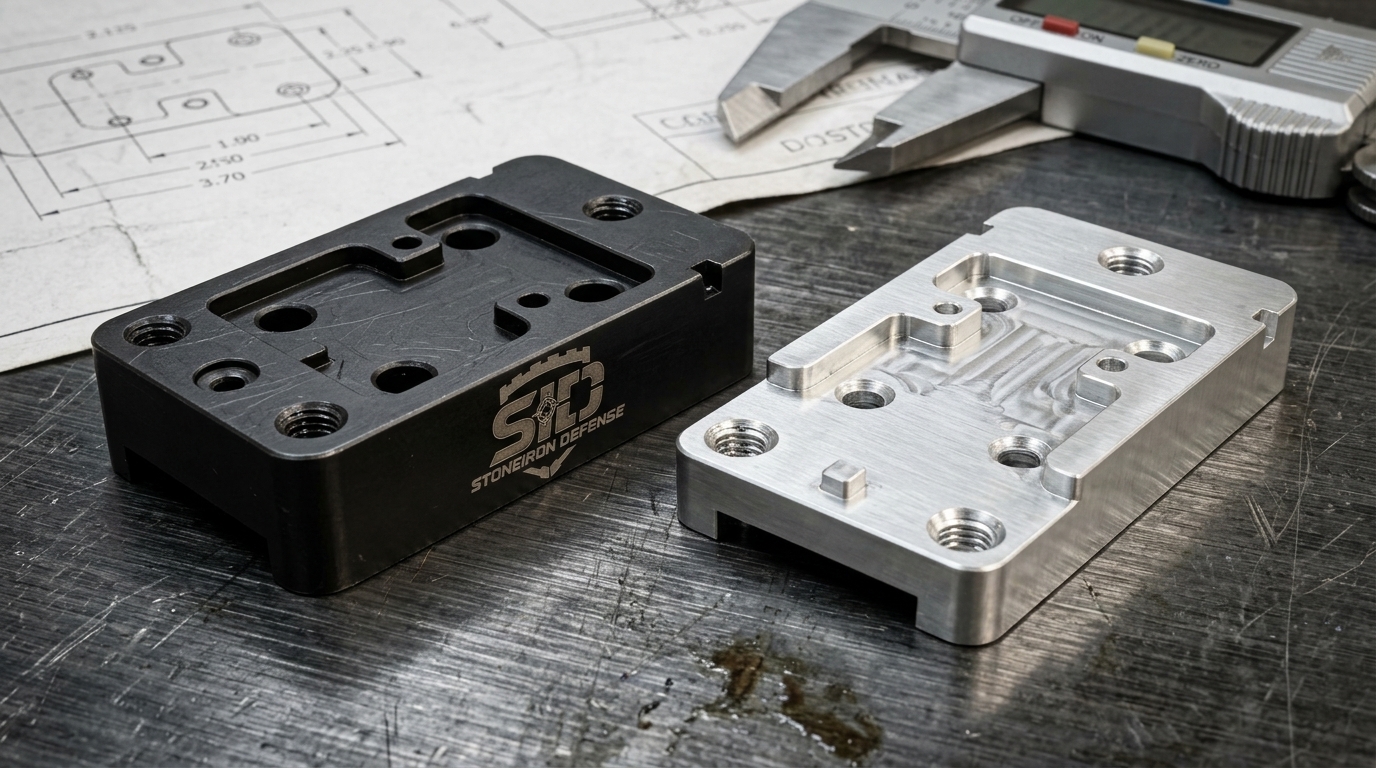
StoneIron Defense lists its Prodigy plates as 4140 steel. EGW lists 7075 aluminum. Springfield Armory says billet steel, without naming a grade.
StoneIron's SID-1158, SID-1159, SID-1160, and SID-1161 all carry the same material entry: "4140 Steel (Stress Relieved & Crack Controlled)." The listing does not state a hardness value, a heat-treat temperature, or a quench-and-temper condition.
EGW's Prodigy plates — SKU 49264 for the Docter footprint and SKU 49566 for the RMR footprint — both list 7075 aluminum. Neither page specifies a temper, such as T6 or T651. Until EGW publishes that detail, "7075 aluminum, temper not publicly specified" is the accurate description.
Springfield's AOS plate page describes its plates as machined from billet steel, with an integral rear sight and screws included. No alloy grade, finish specification, or weight is published.
Material labels on third-party retail listings can be inconsistent. For example, one C&H Precision Prodigy plate appeared as steel under one SKU and as 6061 aluminum under another. Always check the manufacturer's own page before purchasing.
4140 Steel vs 7075 Aluminum Optic Plates
Material Strength and Condition
4140 is a chromium-molybdenum alloy steel whose mechanical properties depend heavily on heat-treatment condition. In the annealed state, it is relatively soft and easy to machine. In the quenched-and-tempered state, its strength and hardness increase significantly, though tempering temperature determines the final balance between hardness and toughness.
Stress relief — which StoneIron lists for its Prodigy plates — is a separate process from hardening. It reduces residual stress left over from machining and improves dimensional stability. It does not produce the hardness levels that full quench-and-temper heat treatment would. Without a published hardness value or heat-treat condition from StoneIron, the actual mechanical state of the finished plate cannot be determined from product documentation alone.
7075 aluminum is a zinc-based alloy used widely in demanding structural applications, including airframe components, because of its high strength-to-weight ratio. Strength also varies by temper. The T6 temper maximizes strength but offers lower resistance to stress-corrosion cracking. The T73 temper improves corrosion resistance at some reduction in strength. Since EGW does not publish a temper for its plates, their exact condition is unknown.
Weight and Density
Steel is considerably denser than aluminum for the same volume. A steel plate will outweigh an aluminum plate of equivalent geometry. Neither StoneIron nor EGW publishes the weight of their Prodigy plates, so no numeric comparison can be made here. What this means practically is that a steel plate adds more mass to the slide, which is a relevant consideration in some competition setups but rarely decisive for most defensive or duty applications.
Corrosion Resistance
Neither steel nor aluminum is inherently corrosion-proof. Unprotected 4140 steel rusts when exposed to moisture. 7075 aluminum has lower inherent corrosion resistance than several other aluminum alloys, particularly in the T6 temper, and is susceptible to stress-corrosion cracking under sustained tensile stress. For both materials, the surface treatment carries most of the corrosion protection in normal use.
Machining and Manufacturing
4140's machinability depends on its hardness and heat-treatment condition. In the annealed state, it machines well. Once hardened, machinability drops and high-precision finishing typically involves grinding. However, the specific sequence a manufacturer uses — whether machining is performed before or after heat treatment, and how final dimensions are achieved — determines the result. StoneIron does not publicly disclose its complete machining and heat-treatment sequence. Inferring that sequence from the material grade alone is not possible.
EGW machines its plates from solid 7075, which is known for good machinability in its tempered forms.
CNC machining establishes the geometry. It does not by itself guarantee a tolerance. The tooling, fixturing, material condition, inspection process, and finished design all determine fit. None of the three makers publishes dimensional tolerances for their Prodigy plates.
How Does Black Nitride Affect Steel Optic Plate Durability?
Black nitride, also called ferritic nitrocarburizing, is a thermochemical surface process applied to steel. Nitrogen and carbon diffuse into the metal's surface, forming an iron nitride layer with a diffusion zone beneath. The result is a darker surface with increased hardness at the surface and potential improvements in wear resistance and corrosion behavior.
Three things that black nitride is not:
- Hardcoat anodize: Anodizing is an electrochemical process that builds an oxide layer on aluminum. It is not interchangeable with black nitride, and aluminum cannot undergo black nitride treatment.
- Black oxide: Black oxide is a conversion coating that darkens steel but provides minimal corrosion protection without oil. It is not the same process.
- Paint or electro-deposition coating: Some steel plates carry a painted finish. These are different finishes; color alone does not identify a process.
StoneIron lists its Prodigy plates as black nitride coated. Its product listings do not include salt-spray test results, surface-hardness measurements, or wear-testing data specific to these plates. The benefits of black nitride described in this article reflect what the process is known to do to steel in general — they are not StoneIron-specific test results.
EGW finishes its Prodigy plates with Type III hardcoat anodizing. This process builds a thick, hard oxide layer on the aluminum surface. Anodizing can substantially improve the corrosion resistance of 7075 aluminum in practical use, though the underlying alloy temper and surface preparation still affect the final result.
Neither finish is maintenance-free in field conditions, and neither manufacturer publishes corrosion-test results for their specific plates.
Are Steel Optic Plates More Durable Than Aluminum Plates?
No independent comparative testing was found for any of the Prodigy plates reviewed. The available evidence does not establish that a steel plate outlasts an aluminum plate, or vice versa.
Material properties — density, hardness, yield strength — describe the alloy in a laboratory condition. A completed plate's behavior under recoil, temperature changes, and sustained use depends on geometry, plate thickness, how the plate seats, screw fit, installation torque, and maintenance. A steel plate with poor screw engagement could fail sooner than a properly installed aluminum plate, and the opposite is equally true.
Both StoneIron and EGW describe their plates as suitable for duty and competition use. These are manufacturer statements, not independently verified results. Until comparative testing with documented methods, conditions, and results exists, neither claim can be ranked against the other.
StoneIron Defense vs EGW vs Springfield Armory
The table below compares RMR-footprint Prodigy plates across all three manufacturers. The Docter/Viper footprint is noted separately where specifications differ.
| Specification | StoneIron SID-1159 | EGW SKU 49566 | Springfield A14B |
|---|---|---|---|
| Product name | Springfield Prodigy Optic Plate for Trijicon RMR / SRO | Trijicon RMR Sight Mount for Springfield Prodigy | AOS Mounting Plate A14B |
| Prodigy compatibility | Springfield Prodigy (1911 DS platform) | All AOS-cut Prodigy models | 1911 DS (AOS models) |
| Optic footprint | Trijicon RMR / SRO | Trijicon RMR / SRO | Trijicon RMR / SRO |
| Listed compatible optics | Trijicon RMR, SRO; Holosun 407C-X2, 507C-X2, 508T; Riton X3 Tactix; Swampfox Justice | Trijicon RMR, RMR HD, SRO; Holosun 407C, 507C, 508T, 507Comp; Swampfox range; Viridian RFX35; Bushnell RXM-300; ADE RD3 models | Trijicon RMR, SRO; Holosun 407C-X2, 507C-X2, 508T; Riton X3 Tactix; Swampfox Justice; Bushnell RXM-300 (irons not visible on RXM-300) |
| Material | 4140 steel | 7075 aluminum | Billet steel |
| Material condition | Stress relieved; crack controlled | Temper not published | Grade not published |
| Manufacturing | Precision CNC machined | CNC machined from solid 7075 | Billet machined |
| Finish | Black nitride | Type III hardcoat anodize | Not specified |
| Integrated rear sight | Yes | No — EGW notes factory-height irons do not co-witness | Yes |
| Dimensions | Not published | 2.184 in long × 0.99 in wide | Not published |
| Plate-to-slide torque | Not published — confirm with StoneIron or a qualified gunsmith | 15 in-lb recommended | 25 in-lb maximum, per Springfield's installation sheet |
| Price (research snapshot) | $74.99 | $49.99 | $129.00 |
Sources: StoneIron SID-1159, EGW 49566, Springfield AOS plate, Springfield installation sheet.
Important note on the Vortex Viper footprint: StoneIron's SID-1158 lists the Crimson Trace CT RAD as compatible. Springfield's own fitment table notes that the CT RAD Pro's supplied screws are not compatible with its equivalent plate code. The model names may differ, but confirm screw compatibility with the optic maker before installing.
EGW also covers the Viper footprint with its SKU 49264, which lists the Vortex Viper, Venom, Burris FastFire 1–4, Docter, and Viridian RFX25.
On torque and screw installation
There are two separate screw interfaces in every AOS plate installation: the plate-to-slide screws and the optic-to-plate screws. These are different interfaces with different specifications.
Springfield specifies 25 in-lb maximum for the plate-to-slide interface, using 6-48 screws and a T10 key. EGW recommends 15 in-lb for its plates. StoneIron does not publish a torque figure for its Prodigy plates. Do not apply another manufacturer's torque value to a StoneIron plate. Contact StoneIron directly or consult a qualified gunsmith for the correct specification.
Optic-to-plate torque comes from the optic manufacturer regardless of which plate you are using.
What Should You Check Before Choosing a Springfield Prodigy Optic Plate?
Before ordering, work through this sequence. Stop at any point where you cannot confirm a detail.
- Pistol and slide cut: Confirm that your specific Prodigy model has the factory AOS cut. The model name should include AOS. Springfield lists AOS variants of the Prodigy, Prodigy Comp, Prodigy Compact, Operator, TRP, Ronin, and Emissary, but EGW's guidance notes that non-AOS versions of these models do not use the cut. Verify your exact pistol.
- Optic model and footprint: Identify your exact optic model, then check its footprint from the optic manufacturer's documentation. Similar-looking optics can use different footprints.
- Plate SKU and compatibility: Match the optic footprint to the correct plate SKU using the manufacturer's fitment list. Springfield's codes run A12B through A19B; third-party makers use different systems.
- Screw length: Springfield's installation sheet states that optic screws must not protrude from the bottom of the plate. Screws that are too long will not anchor the optic and may damage the plate. Check this before final installation.
- Material and condition: Ask for the alloy and condition. "4140 steel" and "7075 aluminum" are starting points, not complete specifications. Stress relief and temper designations matter for understanding what you are installing.
- Finish: Confirm the exact finish name, not just the color.
- Torque specifications: Obtain the plate-to-slide torque value from the plate manufacturer and the optic-to-plate torque from the optic manufacturer. Apply each to the correct interface.
- Iron-sight visibility: Check whether the plate allows co-witnessing with your iron sights. This varies by optic and plate.
- Warranty and support: Check the warranty terms against the specific product listing for the SKU you are buying. Do not assume different SKUs share identical terms.
- Price and availability: Confirm pricing on the day you buy. All prices in this article are research-date snapshots.
For a full AOS compatibility walkthrough including plate codes A12B through A19B and screw notes by optic, see StoneIron's AOS Optic Plate Guide. All plates are also indexed on the StoneIron Springfield Prodigy parts page.
Frequently Asked Questions
Is a steel optic plate better than an aluminum optic plate for the Springfield Prodigy?
Neither material is universally superior. Steel and aluminum differ in density, finish options, and material condition requirements. Performance in service depends on the finished plate design, the quality of installation, and how the complete mounting system is assembled and maintained.
What is a 4140 steel optic plate?
It is a plate machined from AISI 4140, a chromium-molybdenum steel. Its mechanical properties depend on its heat-treatment condition. StoneIron lists its Prodigy plates as stress-relieved and crack-controlled; hardness and heat-treatment cycle are not published.
What is the difference between 4140 steel and 7075 aluminum?
4140 is a steel alloy — denser, with properties that change significantly based on heat treatment. 7075 is a high-strength aluminum alloy whose properties depend on temper. Aluminum is substantially lighter and cannot be black nitrided. Steel requires a surface finish to resist corrosion. Neither outperforms the other categorically in a plate application.
What is black nitride and how does it differ from anodizing?
Black nitride is a thermochemical surface process for steel. It diffuses nitrogen and carbon into the surface, forming a harder iron nitride layer. Hardcoat anodizing is an electrochemical process that builds an oxide layer on aluminum. The two processes work on different base materials and are not interchangeable. Aluminum cannot be black nitrided.
Does black nitride prevent corrosion?
It can improve corrosion behavior on steel compared to unprotected or painted surfaces. No published test results specific to StoneIron's Prodigy plates document how much protection the finish provides or under what conditions. Maintenance is still required.
Are CNC-machined optic plates more precise?
CNC machining allows tight tolerances, but machining method alone does not guarantee a specific fit. Tolerances depend on the tooling, material condition, fixturing, and inspection process. None of the manufacturers reviewed publish dimensional tolerances for their Prodigy plates.
Does a steel optic plate maintain zero better than an aluminum plate?
No published comparative test supports this claim. Zero retention depends on the complete mounting interface — plate fit, screw engagement, installation torque, and how the optic seats — not the plate material alone.
Are StoneIron Defense and EGW plates made from the same material?
No. StoneIron's Prodigy plates are 4140 steel. EGW's Prodigy plates are 7075 aluminum. Springfield Armory's plates are billet steel; grade not specified.