
AOS Optic Plate Guide: Springfield Fitment & Compatibility
Sep 29th 2026
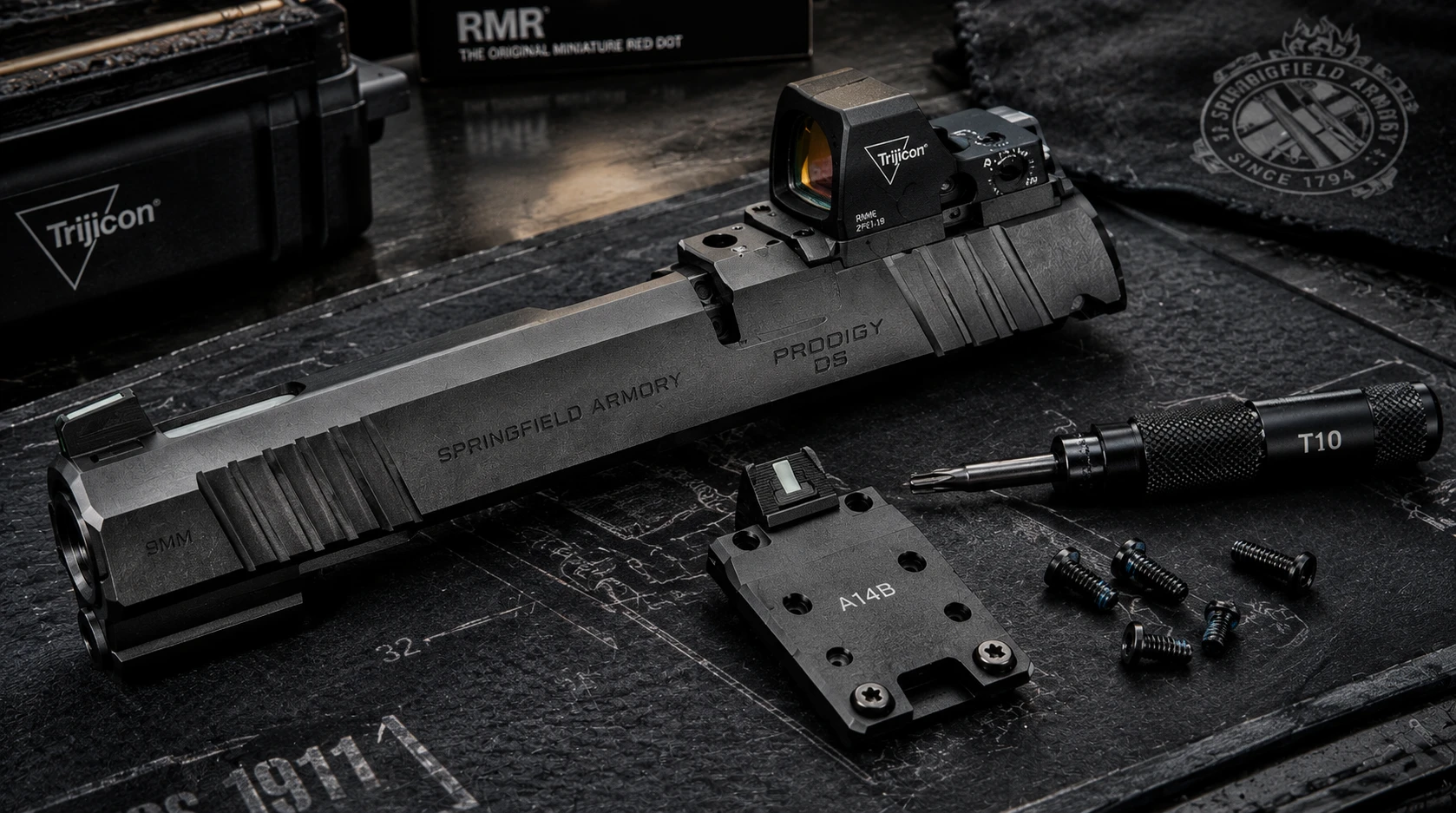
An AOS optic plate is the interchangeable mounting plate used on Springfield Armory pistols with the Agency Optic System cut. Each plate adapts the slide to one family of red dot footprints. Springfield developed AOS with Agency Arms, and the plates cover the RMR, Shield, DeltaPoint Pro, and Docter footprints.
StoneIron Defense (SID) created this guide for one practical problem: you have a Springfield AOS pistol and an optic, and you need to know which plate to buy and what to verify first. It covers which pistols use the AOS cut, which plate code matches which optic, what the manufacturer documents about installation, and where the limits are. Every fitment claim is attributed to its source, and anything unverified is flagged for confirmation with Springfield Armory or a certified gunsmith.
Quick AOS Optic Plate Compatibility
The table below condenses Springfield's fitment listing by optic. "Iron sights visible" means Springfield marks the plate's rear sight as visible with that optic. "Screw note" reflects Springfield's comment on the optic's own supplied screws.
| Optic | AOS plate | Iron sights visible | Screw note (per Springfield) |
|---|---|---|---|
| HEX Wasp | A12B | Yes | Supplied screws compatible |
| Holosun 507K-X2 | A12B | Yes | May need modification |
| Holosun 407K-X2 | A12B | Yes | May need modification |
| Shield RMSc | A12B | Yes | Supplied screws compatible |
| Shield SMSc | A12B | Yes | Supplied screws compatible |
| Shield RMS2 | A12B | Yes | Supplied screws compatible |
| Swampfox Sentinal | A12B | Yes | Supplied screws compatible |
| Bushnell RXC-200 / RXU-200 | A12B | Yes | May need modification |
| HEX Dragonfly | A13B | Yes | Supplied screws compatible |
| Vortex Viper | A13B | Yes | Supplied screws compatible; zero lock not accessible |
| Burris FastFire 4 | A13B | Yes | Supplied screws compatible |
| Burris FastFire 2 | A13B | Yes | May need modification |
| Crimson Trace CT RAD Pro | A13B | Yes | Supplied screws not compatible |
| Trijicon RMR | A14B | Yes | May need modification |
| Trijicon SRO | A14B | Yes | May need modification |
| Holosun 407C-X2, 507C-X2, 508T | A14B | Yes | May need modification |
| Riton X3 Tactix | A14B | Yes | May need modification |
| Swampfox Justice | A14B | Yes | May need modification |
| Bushnell RXM-300 | A14B | No | May need modification |
| Leupold DeltaPoint Pro | A15B | No | Supplied screws compatible |
| EOTech EFLX | A15B | Yes | Supplied screws compatible |
| Bushnell RXS-250 / RXS-100 | A15B | Yes | Supplied screws compatible |
| Aimpoint ACRO | A18B | Yes | No note listed |
| Holosun 509T | A19B | Yes | No note listed |
If your optic isn't in this table, don't assume it fits a plate just because its footprint looks similar. Confirm with Springfield Armory or a certified gunsmith. Springfield's listing can change, so recheck it before you buy.
What an AOS Optic Plate Is
Direct answer: An AOS optic plate sits in a factory-milled recess in the slide and carries the mounting pattern for a specific red dot. Changing optic footprints means changing the plate rather than re-milling the slide.
EGW, an aftermarket manufacturer, describes the cut as a modular platform that accepts interchangeable plates, each designed around a specific red dot footprint. Springfield's listing says each plate is machined from billet steel and has an integral rear sight. It also says each plate ships with screws to mount the plate to the handgun.
The integral rear sight is what separates AOS plates from generic adapter plates. Springfield says pistols with the AOS cut ship with a cover plate carrying a rear sight, so the pistol has usable iron sights before an optic is fitted. This is a manufacturer description, not an independent test.
Which Springfield Pistols Use the AOS Cut
Direct answer: Only pistols Springfield marks as AOS models use the cut. The model name is the first thing to check.
Springfield's AOS page lists AOS versions of the 1911 DS Prodigy (including Comp and Compact variants), 1911 Operator, 1911 TRP, 1911 Ronin, and 1911 Emissary. EGW's guide lists a narrower set: Prodigy, Prodigy Comp, Prodigy Compact, TRP AOS, and Operator AOS. It says non-AOS Ronin, Emissary, and other models do not have the cut.
The two sources differ on Ronin and Emissary AOS variants. Springfield is the primary authority for its own product compatibility, and EGW is third-party guidance. Compatibility information can change, so confirm your exact model and configuration with Springfield before buying a plate. Treat any model that is not clearly marked AOS as unconfirmed rather than compatible.
One further wording difference: Springfield's plate listing is titled for the 1911 DS/1911, but its description refers to plates designed for the 1911 DS. Another reason is to confirm your specific pistol directly.
AOS Plate Codes and Optic Fitment
Springfield's store lists six plate configurations. Here is what each covers, per the table above:
- A12B: HEX Wasp, Holosun K-series (407K-X2, 507K-X2), Shield RMSc/SMSc/RMS2, Swampfox Sentinal, and Bushnell RXC-200/RXU-200.
- A13B: HEX Dragonfly, Vortex Viper, Burris FastFire 2 and 4, and Crimson Trace CT RAD Pro.
- A14B: Trijicon RMR and SRO, Holosun 407C-X2, 507C-X2 and 508T, Riton X3 Tactix, Swampfox Justice, and Bushnell RXM-300.
- A15B: Leupold DeltaPoint Pro, EOTech EFLX, and Bushnell RXS-250/RXS-100.
- A18B: Aimpoint ACRO.
- A19B: Holosun 509T.
Two points from Springfield's fitment listing matter for buying decisions:
- Co-witness is not universal. Springfield's marketing describes a visible co-witness in nearly all optic configurations. Its own fitment table marks the Bushnell RXM-300 and Leupold DeltaPoint Pro as exceptions. The table is the more specific source.
- Screw compatibility is a separate check from plate fitment. "May need modification" means the optic's supplied screws may protrude past the plate. The installation section below covers why that matters.
Plate codes are Springfield's. Third-party makers group optics differently. EGW's K-series plate, for example, covers Holosun K-series, Shield RMSc, and DeltaPoint Pro footprint optics together, while Springfield splits those across A12B and A15B. Do not carry a Springfield plate code over to another maker's plate.
How to Choose the Right AOS Optic Plate
Use this sequence and stop at the first failure:
- Confirm the exact Springfield pistol.
- Confirm it has the factory AOS cut. The model name must include AOS. EGW states that a pistol not specifically marked AOS should not be assumed to use the system.
- Identify the exact optic model. Similar-looking optics can use different footprints, so match by model, not by appearance.
- Identify the optic's footprint from the optic manufacturer's documentation. EGW's guide says to choose the plate by optic footprint, not by pistol model alone.
- Match the optic to the AOS plate code in Springfield's fitment listing.
- Check iron-sight visibility if a co-witness matters to you.
- Check optic screw compatibility. If the note says "may need modification," plan for correct-length screws before mounting.
Verify anything unlisted with Springfield, the optic manufacturer, or a certified gunsmith. Do not infer fitment from visual similarity.
Before You Buy an AOS Optic Plate
SID's aim with this guide is to help you verify fitment before you spend money. Confirm each of these against current manufacturer information:
- The exact pistol model and configuration
- The AOS designation and factory cut on your slide
- The exact optic model
- The optic's footprint
- The AOS plate code Springfield lists for that optic
- Whether the iron sights remain visible with that optic
- Whether the optic's supplied screws are compatible or need modification
- That the fitment listing you are relying on is current
Factory Springfield vs Third-Party AOS Plates
Springfield's plates and EGW's plates are both documented in the sources reviewed. The facts below come from each maker's own materials. Neither source provides a head-to-head test, so this comparison does not rank them.
| Attribute | Springfield Armory | EGW (third-party) |
|---|---|---|
| Material | Billet steel | 7075 aluminum |
| Plate lines | Six codes: A12B, A13B, A14B, A15B, A18B, A19B | Three lines: RMR/SRO family; K-series/RMSc/DeltaPoint Pro family; Viper/Venom/Docter family |
| Listed pistols | Springfield's AOS model list | Prodigy, Prodigy Comp, Prodigy Compact, TRP AOS, Operator AOS |
| Rear sight | Integral rear sight (Springfield) | Not documented in the EGW guide reviewed |
| Installation guidance | Published sheet: 6-48 screws, T10 key, 25 in-lb maximum | Guide reviewed lists no torque; states minor fitment may be required |
| Support | Springfield Armory | EGW |
If you choose a third-party plate, follow that maker's installation and torque guidance. Do not assume Springfield's 25 in-lb figure applies to another maker's plate unless that maker says so.
Installation Guidelines
The steps below summarize Springfield's published instructions. They do not replace them. Read the full manufacturer sheet, and use a certified gunsmith if you are unsure.
Springfield's sheet says to unload the pistol, verify it is safe, and remove the slide from the frame. It says not to change plates with the pistol assembled. The two factory 6-48 screws come out with a T10 key, and the front of the fixed sight plate lifts off.
Before mounting an optic on the new plate, screw length needs attention. Springfield says to verify that the optic's screws do not protrude from the bottom of the plate. If they do, the screws must be shortened or replaced with the correct length, because screws that are too long will not anchor the optic and may damage the plate.
The plate engages the rear recess of the slide at roughly a 30-degree tilt, then the front rotates down. Springfield says the plate should drop into place without force. The two plate screws are then installed to meet but not exceed 25 in-lb. If thread-locking compound is used, Springfield says to use it sparingly and on screws only, since too much can foul the mechanism. The optic is then mounted per its own manufacturer's directions, and the slide goes back on the frame.
There are two separate torque questions:
- Plate-to-slide torque: Springfield specifies a maximum of 25 in-lb on the two 6-48 plate screws.
- Optic-to-plate torque: The sources reviewed give no value. The optic manufacturer determines that specification, so follow the instructions supplied with your optic.
Do not substitute a generic tightening rule for the specified torque. Use a torque driver set to the manufacturer's value.
Practical Use and Trade-offs
Flexibility versus a direct cut. A plate system lets one slide accept several footprints. A direct-milled slide has one fewer interface between optic and slide. That second point is a general design consideration, not a measured result from the sources reviewed.
Sight picture. Springfield describes the integral rear sight as setting proper optic height. That is a manufacturer claim. The fitment table shows co-witness varies by optic.
Zero and accessibility. Springfield notes the Vortex Viper's zero lock is not accessible on the A13B plate. Plate and optic combinations can change which optic features you can reach.
Forum anecdote. One user on a 1911 forum reported that the rear of an AOS plate contacted the slide's rear sight on a Ronin AOS and would not seat. The same user reported the plate stayed mounted through 150 rounds of .45 ACP ball ammunition. This is a single user report, not an engineering finding. It does not apply to all AOS plates or all Ronin models. It does support checking seating before torquing.
Limitations
- Plates are optic-specific, so a new optic on a different footprint means a new plate.
- Fitment information comes from Springfield's listing and can change as new plates are added. Recheck before purchase.
- Springfield's store listed the plate at $129 at the time of research, and pricing is subject to change.
- The sources reviewed publish no plate weight, no independent impact or zero-retention testing, and no optic-to-plate torque values. SID has not independently tested any AOS plate for this guide.
Maintenance
The sources reviewed give no inspection interval for AOS plates. What they do specify: use thread locker sparingly and on screws only, and never exceed the 25 in-lb limit when reinstalling. Follow the optic manufacturer's guidance for the optic-to-plate screws. If a plate or optic shifts, stop using the pistol and have a certified gunsmith inspect it.
Frequently Asked Questions
What does AOS stand for on a Springfield pistol?
Agency Optic System. It was developed in collaboration with Agency Arms and uses a factory cut that accepts interchangeable plates.
Which AOS plate do I need for my optic?
It depends on the exact optic model. Find your optic in the compatibility table above, which follows Springfield's listing. Examples: Trijicon RMR and SRO are listed on A14B, Leupold DeltaPoint Pro on A15B, Aimpoint ACRO on A18B, and Holosun 509T on A19B. If your optic is not listed, confirm with Springfield.
What is the difference between A12B, A13B, A14B, A15B, A18B, and A19B?
They are Springfield's plate codes, each listed for a different group of optics. The optic-to-code mapping is in the plate codes section above. Springfield's sources reviewed do not describe the physical differences between plates beyond their optic listings.
Does every AOS plate work with every Springfield AOS pistol?
Springfield's listing presents the plates as part of the AOS system, but the sources reviewed do not confirm every plate on every model. Confirm your exact pistol with Springfield.
Do the Ronin and Emissary use the AOS cut?
Springfield lists AOS versions of both. EGW says non-AOS versions of these models do not have the cut. Check that your pistol is specifically an AOS model, and confirm with Springfield if unsure.
How do I verify an optic's footprint before buying a plate?
Check the optic manufacturer's documentation for the footprint or mounting pattern, then match the exact optic model to Springfield's fitment listing. Similar-looking optics can use different footprints.
Why might an optic's supplied screws need modification?
Springfield says screws that protrude from the bottom of the plate will not anchor the optic properly and may damage the plate. For several optics, Springfield's listing notes the supplied screws may need modification. Verify screw length before mounting.
What torque should I use for the plate screws?
Springfield's instructions say to meet but not exceed 25 in-lb on the two 6-48 plate screws. Optic-to-plate torque comes from the optic manufacturer.
Will the factory rear sight stay visible with my optic?
It depends on the optic. Springfield's table marks most listed optics as irons visible, with the Bushnell RXM-300 and Leupold DeltaPoint Pro as exceptions.
Conclusion and Key Takeaways
An AOS optic plate is an optic-specific, interchangeable plate for Springfield pistols with the factory Agency Optic System cut. This StoneIron Defense guide is meant to help you verify fitment before you buy or install one.
Confirm the pistol is an AOS model first. Springfield's list is broader than one aftermarket maker's, so verify your exact model.
Match the plate to the exact optic using Springfield's codes: A12B, A13B, A14B, A15B, A18B, A19B.
Check the iron-sight and screw notes. Both vary by optic.
Springfield's installation sheet specifies 6-48 screws, a T10 key, and no more than 25 in-lb for the plate, with the pistol unloaded and the slide removed. Optic-to-plate torque comes from the optic manufacturer.
Anything not in the manufacturer's documentation, including unlisted optics, weights, and third-party plate torque, needs confirmation from Springfield, the optic maker, the plate maker, or a certified gunsmith.