Choosing the Right Scope Rings for Ultimate Precision and Accuracy
Sep 11th 2026
If you've spent serious time behind a precision rifle, you already know that barrel quality, ammunition consistency, and trigger control matter. But here's what separates sub-MOA shooters from everyone else: they obsess over the parts nobody sees—the ones holding their glass to the rail. Your scope rings aren't just fasteners. They're the mechanical interface between your optic and your rifle, and they directly determine whether your zero stays put when a 300 Win Mag fires through your shoulder or whether you're chasing impacts downrange.
I've watched shooters spend $3,000 on premium optics and $400 on ammunition, then mount it all with rings that shouldn't have left the factory. The result? Scope creep, zero shift, and the kind of frustration that ends shooting sessions early. That's why understanding scope ring selection isn't a peripheral skill—it's fundamental to long-range precision.
The Three Foundational Factors: Rail Type, Tube Diameter, and Ring Height
Before you even open a product page, you need to nail down three non-negotiable specifications. Get these wrong, and no amount of precision elsewhere recovers your accuracy.
Rail Type: Picatinny vs. Weaver vs. Dovetail
Your rifle's mounting surface determines which rings will physically fit and function properly.
| Rail Type | Standard | Common Application | Precision Suitability | Adjustability |
|---|---|---|---|---|
| Picatinny | Military MIL-STD-1913 | Modern tactical rifles, AR platforms | Excellent—tight tolerances | Full (forward/backward) |
| Weaver | Proprietary spacing | Hunting rifles, legacy builds | Moderate—compatibility risk | Limited |
| Dovetail | Fixed grooves | Traditional hunting rifles, vintage | Good when properly engineered | None—fixed position |
Picatinny Rail Details:
The Picatinny rail is the military standard and dominates modern tactical rifles. It features precisely spaced crossslots cut at a specific angle (20 minutes of arc) that allow standardized ring bases to clamp securely without a purchase-surface mismatch.
Weaver Rail Considerations:
The Weaver rail is subtly different—crossslots that don't quite match Picatinny specs, though many Weaver-designed rings work acceptably on Picatinny rails due to a degree of compatibility. However, I never recommend counting on this compatibility for precision work. The clearance tolerance variance introduces repeatability risk.
Dovetail Mount Reality:
The dovetail mount remains common on traditional hunting rifles and legacy precision platforms. These fixed-position grooves require rings specifically engineered for dovetail attachment. They're reliable when properly designed, but they lack the adjustability that Picatinny rails provide.
Tube Diameter: 1 Inch or 30mm
This is the scope's central tube dimension, and it's non-negotiable.
Quick Reference:
- 1-inch tube scope requires 1-inch rings only
- 30mm tube scope requires 30mm rings only
- No cross-compatibility exists
A 1-inch scope in a 30mm ring will shift under recoil. A 30mm scope in a 1-inch ring won't fit at all.
Here's the practical consideration: 30mm tubes hold wider reticle images and offer superior windage and elevation adjustment clearance within the tube. That clearance matters when your turrets live near mechanical limits. For precision long-range shooting—3,000 yards and beyond—30mm is becoming the industry standard precisely because it solves the clearance problem elegantly.
Ring Height: Low, Medium, High
Ring height directly affects optical geometry and shooter comfort. The wrong height introduces multiple problems simultaneously.
| Height Class | Rail Standoff | Best For | Advantages | Disadvantages |
|---|---|---|---|---|
| Low | 0.25–0.4" | Flat-top barrels, target rifles | Natural cheek weld, aggressive positions | Minimal objective clearance, limited turret space |
| Medium | 0.50–0.65" | Most hunting rifles, tactical platforms | Balanced sight picture, adequate clearance | Requires proper cheek position |
| High | 0.75–1.0" | Heavy barrels, large objectives | Maximum clearance, full adjustment range | Unnatural head position, cant risk |
Selection Process:
- Measure your barrel's highest point at the mounting location (typically 0.5 to 1 inch above the rail)
- Measure your scope's objective bell diameter
- Calculate clearance: you want a minimum of 0.25 inches between the barrel and bell
- Account for your shooting position—prone, bench, or tactical stance
- Test with sandbags before committing to rings
Common Scenarios:
- Conventional hunting rifle with standard profile barrel → Medium rings (0.5")
- AR-15 platform with rail-mounted scope → Medium to High (0.5–0.75")
- Competition F-class rifle with heavy match barrel → High rings (0.75–1.0")
- Precision youth or compact rifle → Low rings (0.25–0.4")
Material and Construction: Why Aircraft-Grade Aluminum Isn't a Compromise
Scope rings endure extraordinary mechanical stresses. When a 7mm Rem Mag fires, the rifle accelerates rearward at hundreds of Gs in milliseconds. Your rings must maintain their clamping pressure and mechanical geometry throughout thousands of firing cycles.
| Property | Aircraft-Grade Aluminum (6061-T6+) | Tool Steel / 4340 Steel |
|---|---|---|
| Strength-to-Weight | Excellent | Good but heavier |
| Machinability | Superior—enables tight tolerances | Difficult—compromises precision |
| Tolerance capability | ±0.0005–0.001" achievable | ±0.001–0.002" typical |
| Recoil performance | Optimal damping, no ringing | Can transmit vibration |
| Long-range precision | Best choice | Overkill for non-abuse scenarios |
| Cost | Moderate | Higher (material + labor) |
Aircraft-Grade Aluminum Advantages:
The best construction starts with material selection. Aircraft-grade aluminum (6061-T6 or superior) offers an exceptional strength-to-weight ratio and excellent machinability, allowing engineers to hold extraordinarily tight tolerances. Properly designed aluminum rings actually outperform marginal steel rings because the precision engineering can be tighter, and weight distribution across the rifle is more balanced.
Precision Manufacturing Standards
However, material choice only matters if paired with precision manufacturing. A properly engineered scope ring requires:
- Diametral tolerances: ±0.001 inches or tighter on all internal clamping surfaces
- Spherical bearing surfaces: Perfectly concentric, maintaining roundness across 360 degrees
- Surface finish: 16 microinches Ra minimum on clamping zones
- Hardness verification: Material properly heat-treated to specification
- Runout control: Total indicated runout (TIR) under 0.0005 inches
At this level of precision, internal spherical bearing surfaces remain perfectly concentric, clamping pressure distributes evenly around the tube's circumference, and the scope never migrates within the ring.
Steel Ring Reality:
Steel rings excel in extreme-abuse environments where impact resistance matters more than precision. But for long-range precision shooting, that's overkill. The tradeoff in precision engineering makes it a poor choice. You're paying for durability you don't need while sacrificing the manufacturing precision that directly improves accuracy.
The Clamping Mechanism: Where Engineering Becomes Critical
This is where most precision-blind shooters stumble. The clamping mechanism determines how consistently your scope stays zeroed and how much mechanical play develops over time.
| Mechanism | Clamp Type | Pressure Control | Consistency | Zero Drift Risk | Best Use |
|---|---|---|---|---|---|
| Lever-Action | Rotating lever | Non-linear | Hand-feel dependent | Moderate to High | Budget hunting rings |
| Screw-Clamp (Torque Spec) | Threaded fasteners | Precise, linear | Excellent (±5%) | Very Low | Precision & long-range |
| Quick-Detach Lever | Spring-loaded arms | Moderate | Depends on design | Low to Moderate | Tactical / switching scopes |
Lever-Action Ring Limitations:
Lever-action rings clamp via rotating levers that push against the tube. Simple and reliable, but the clamping pressure ramps up non-linearly as you tighten. It's easy to under-clamp or—worse—over-tighten and compress the tube. Scope tubes aren't infinitely rigid; excessive clamping pressure can actually deform the tube slightly, affecting reticle alignment.
Screw-Clamp Advantage:
Screw-clamp rings use threaded fasteners to apply clamping force. When properly designed with a torque wrench applied to specification (typically 15-25 inch-pounds, depending on the ring), screw clamps deliver repeatable, consistent pressure. No guessing. No hand-feel variation. The engineering advantage is enormous.
The Recoil Lug: Silent Guardian Against Zero Shift
The recoil lug—a rear mechanical stop inside the ring that the scope's tube shoulder seats against—is equally critical. This lug carries the rearward recoil impulse before clamping pressure engages, preventing the scope from rocking under recoil.
A properly engineered recoil lug must have:
- Hardened steel construction (minimum 48 HRC hardness)
- Perfect parallelism with the scope tube's rear shoulder (within 0.0005")
- Zero deflection under typical recoil loads
- Adequate bearing surface to distribute impulse evenly
A poorly designed lug (too thin, misaligned, or with sloppy tolerances) allows microscopic movement that compounds over hundreds of shots. This is where sub-MOA groups gradually become 1.5 MOA groups without explanation.
Windage and Elevation Adjustment Clearance: The Silent Zero-Shift Killer
Here's a field-tested insight most hunters never encounter: your elevation turret can hit your rail or your ring, physically preventing full elevation adjustment travel. Similarly, windage adjustments can bind if your turret design doesn't account for ring height and base geometry.
Clearance Measurement Protocol
Before mounting, verify these critical clearances:
- Elevation turret to ring cap: Measure vertical distance from turret top to ring cap bottom. Minimum acceptable clearance: 0.15 inches. Optimal clearance: 0.25 inches or greater. At less than 0.1 inches: binding risk is severe.
- Windage turret to ring side: Measure horizontal distance from turret side to ring exterior. Minimum acceptable clearance: 0.10 inches. Optimal clearance: 0.20 inches or greater.
- Objective bell to barrel: Measure distance from bell front to barrel. Minimum acceptable clearance: 0.25 inches. Optimal clearance: 0.40 inches or greater.
- Eyepiece to shooter's face: Ensure no contact during recoil. Typical safe distance: 2.5–3.0 inches from objective lens to your eyebrow.
The Binding Trap
Measure your scope's turret height above the tube centerline. Cross-reference this against your ring's top geometry. If clearance is less than 0.1 inches, you're playing Russian roulette with mechanical binding. When a turret binds mid-adjustment, it doesn't fail obviously—it just stops rotating smoothly, and shooters often assume they've reached mechanical limit and stop turning. Result: your dialed elevation never actually reached the target, but you don't know it until you're downrange.
Why 30mm Tubes Eliminate the Problem
30mm tubes win here. The additional radial space around the turret cluster permits more aggressive dial sizing and eliminates most clearance constraints entirely. This is why precision competitors and long-range hunters increasingly specify 30mm platforms.
30mm vs. 1-inch radial advantage:
- Extra 5mm of radius = 10mm additional diameter
- Turrets can be positioned further from scope axis
- Adjustment travel never interferes with ring geometry
- Wider reticle images also permitted by larger tube
Base Compatibility and Cant Prevention
Your rings mount to a base that attaches to your rail. This two-piece system introduces a potential weak link: poor base-to-ring interface tolerances can allow rotational play that introduces cant—the scope's axis tilting relative to the bore.
Canted mounts sound like a small problem. They're not. A 2-degree cant on a 1,000-yard shot introduces roughly 35 inches of windage error. The shooter compensates by dialing windage, which works at that range but fails catastrophically at other distances because the cant error is now baked into every elevation adjustment.
Premium precision-machined optic mounts and rings maintain base-to-ring interface tolerances so tight that rotational play is physically impossible. The rail interface sits flush, the base geometry is perfectly parallel, and the ring clamps the base to prevent any tilting. This isn't paranoia—it's how sub-MOA precision remains possible across distance changes.
Installing Your Rings: The Torque Wrench is Non-Negotiable
Installation is where theory meets reality. Many precision shooters understand ring selection intellectually but fail in execution by hand-tightening fasteners without a torque wrench.
The Hand-Tightening Trap
Here's what happens: your hand estimates tightness, applies what feels like "firm" pressure, and moves on. Over 50 shots, the recoil impulse works fasteners loose slightly. At 100 shots, your zero has crept half an MOA. At 200 shots, it's wandered a full MOA. You blame the rifle. You blame the ammo. You never suspect the rings.
A torque wrench eliminates this guesswork entirely. Tighten all fasteners to specification—typically 15-25 inch-pounds for ring cap screws—and your clamp pressure stays consistent. No more. No less. Recoil impulses work against mechanical design that expects this force, not against your approximation.
Torque Specifications by Component
| Component | Material | Typical Torque Range | Notes |
|---|---|---|---|
| Ring cap screws (aluminum) | Steel fasteners | 15–20 in-lbs | Start at lower end, increase if slippage occurs |
| Ring cap screws (steel rings) | Steel fasteners | 18–25 in-lbs | Higher torque acceptable due to material rigidity |
| Base to rail fasteners | Picatinny mount | 20–30 in-lbs | Verify with manufacturer—varies by base design |
| Reticle focus collar | Internal mechanism | 12–18 in-lbs | Over-torquing can damage internal optics |
Step-by-Step Installation Protocol
Pre-Installation Verification:
- Verify rail type matches ring base (Picatinny or Weaver)
- Confirm tube diameter (1 inch or 30mm)
- Measure objective bell clearance to barrel
- Check turret clearance to ring cap
- Inspect all fasteners for damage or defects
- Ensure torque wrench is calibrated (±4% accuracy)
Mount Installation:
- Clean the rail with a dry cloth—remove any dust or debris
- Position the base on the rail, aligned with bore centerline
- Hand-tighten all base fasteners loosely (no torque wrench yet)
- Verify base alignment by sighting through bore
- Tighten base fasteners in a cross-pattern with torque wrench (20–30 in-lbs per manufacturer spec)
Ring Installation:
- Position the lower ring halves on the base
- Place the scope in the rings—do not clamp yet
- Hand-tighten all ring cap screws loosely
- Level the reticle (use a bubble level on the turret top)
- Apply torque in a four-point cross-pattern:
- Front-left cap screw: 15 in-lbs
- Rear-right cap screw: 15 in-lbs
- Front-right cap screw: 15 in-lbs
- Rear-left cap screw: 15 in-lbs
- Wait 2 minutes, then re-verify level
- Apply final torque to specification (repeat cross-pattern if needed)
Post-Installation Verification:
- Sight through bore—verify scope axis alignment
- Rotate elevation turret through full range—no binding
- Rotate windage turret through full range—no binding
- Check for any scope movement or rocking in rings
- Fire 5 shots at 25 yards
- Check for zero shift after 50 rounds
- Re-verify torque specification after 100 rounds (fasteners may settle)
Choosing High-Performance Scope Rings: What Actually Matters
When you're evaluating options, skip the marketing language and focus on engineering fundamentals.
Ring Quality Assessment Checklist
Clamping Design:
- Screw-clamp mechanism (not lever-action for precision work)
- Documented torque specifications provided
- Fasteners are hex socket (Allen key) for consistent application
- All fasteners are steel, not aluminum or cheap alloys
Material & Manufacturing:
- Aircraft-grade aluminum (6061-T6 or better) or hardened steel
- Manufacturer publishes diametral tolerance specs (±0.001" or tighter)
- All internal surfaces finished to 16 microinches Ra or smoother
- Physical samples available for inspection before bulk purchase
Recoil Lug Engineering:
- Hardened steel recoil lug (minimum 48 HRC)
- Recoil lug visibly seats flush against scope tube shoulder
- No rocking or play when light rearward pressure is applied
- Bearing surface is parallel to tube axis (inspect with straightedge)
Bearing Surface Quality:
- Internal bearing surfaces are truly spherical (not just rounded)
- Bearing surfaces feel smooth—no tool marks or interruptions
- Scope tube has zero play when hand-twisted in ring (before torque)
- Weight is distributed evenly around the tube (rings balance identically)
Rail Interface & Cant Prevention:
- Base mounting surfaces are parallel and flush
- Base seats completely flat on Picatinny rail (no rocking)
- No gaps between base and rail surface
- Fastening system prevents base rotation under recoil
Clearance Geometry:
- Elevation turret clearance ≥0.15" from ring cap
- Windage turret clearance ≥0.10" from ring side
- Objective bell clearance ≥0.25" from barrel
- Eye relief adequate for your shooting position
StoneIron Defense Engineering
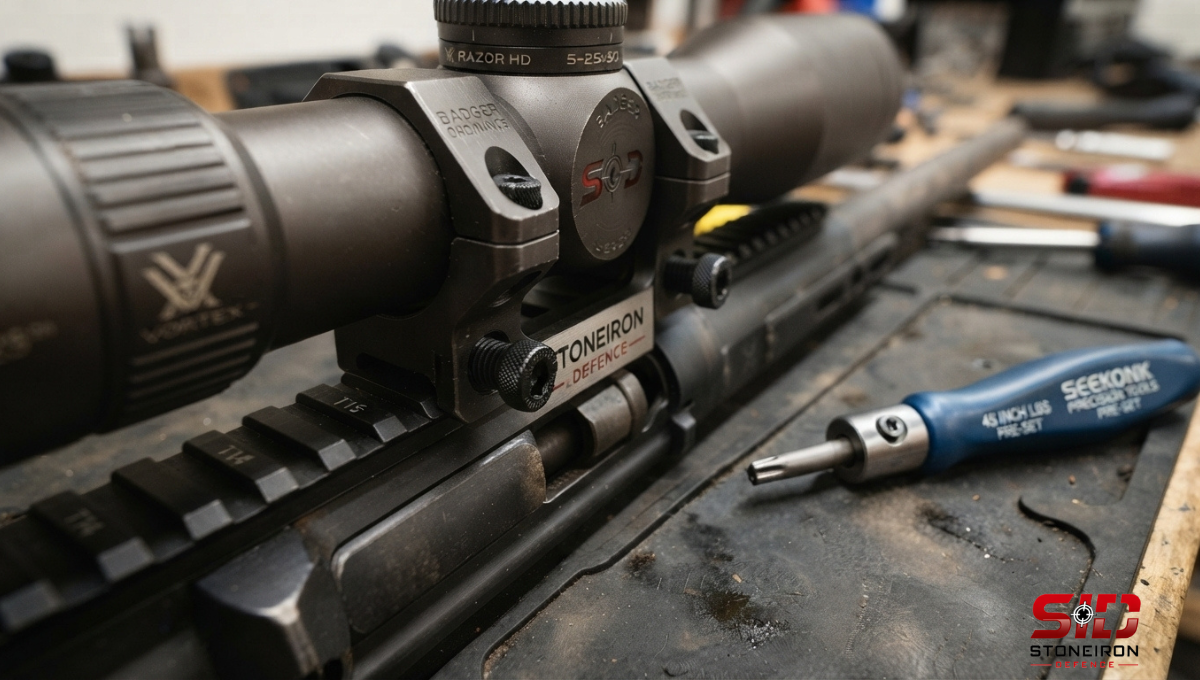
StoneIron Defense (SID) engineered rings specifically around these principles. Aircraft-grade aluminum construction held to ±0.001-inch tolerances, spherical bearing surfaces that maintain perfect concentricity, and recoil lug geometry designed to carry impulse loads without deflection. The rings clamp via precision screw design with documented torque specs, and the base interface locks cant-free onto Picatinny rails.
When you choose the correct ring height for your barrel profile, mount them with a torque wrench at specification, and trust the precision engineering underneath, your zero doesn't wander. Your impacts don't creep. You stop chasing ghosts and start hitting targets consistently.
The Final Takeaway: Precision Starts Invisible
Your scope rings aren't glamorous. They don't appear in photos of your rifle. They don't improve ballistics or ammunition consistency. But they determine whether all your other investments—premium glass, tight ammunition, quality barrel—actually deliver precision downrange or just promise it.
Choosing the right scope rings means understanding your rail type, measuring your tube diameter, calculating proper ring height, and selecting precision-machined construction with documented tolerances. It means embracing a torque wrench rather than hand-feel, and verifying clearance before you fire a shot.
The best shooters I know obsess over these details. They understand that sub-MOA performance isn't luck—it's mechanical consistency across hundreds of variables. Choosing the correct ring height for your specific barrel profile eliminates one critical variable. Pairing it with precision construction and proper installation eliminates another.
When your zero stays put from the first shot through the last string, when your elevation adjustments dial predictably across distance changes, and when your impacts group tighter than your rifle should theoretically allow, you'll understand why the best precision shooters obsess over rings. They're not buying fasteners. They're buying mechanical certainty.
Ready to upgrade? Explore StoneIron Defense's high-performance scope rings engineered for the precision that competition and long-range hunting demand. Or dive deeper into how to select the perfect fit with our guide to precision optic mounts and rings.
Your next record group depends on it.