
Maintaining Your Firearm for Long-Term Reliability: The Ultimate Guide
Apr 24th 2026
Whether you use your firearm for personal defense, range practice, or field duty, one reality remains constant: mechanical reliability is non-negotiable. A firearm is a high-precision mechanical tool. Over time, heat, friction, carbon fouling, and environmental moisture conspire to wear down critical tolerances and cause preventable malfunctions.
At STONEIRON DEFENSE LLC, we emphasize that firearm maintenance is not just a post-range chore—it is a core safety discipline. Proper cleaning, lubrication, inspection, and storage ensure that every component functions flawlessly when you need it most.
In this comprehensive guide, we break down the step-by-step process of maintaining your firearms for long-term durability and peak performance.
1. Safety First: The Four Universal Rules Before Maintenance
Before touching a single cleaning tool or chemical solvent, safety protocols must be strictly enforced. Maintenance routines involve handling firearms in proximity, making absolute clearing mandatory.
- Rule 1: Treat Every Firearm as If It Is Loaded. Never assume a firearm is empty, even if you just cleared it 10 seconds ago.
- Rule 2: Keep the Muzzle Pointed in a Safe Direction. Always orient the barrel toward a safe backstop where an accidental discharge cannot cause harm.
- Rule 3: Keep Your Finger Off the Trigger. Keep your index finger indexed high along the frame until you are ready to shoot.
- Rule 4: Know Your Target and What Is Beyond It. Maintain environmental awareness at all times.
Mandatory Clearing Sequence
- Remove the magazine or ammunition source entirely from the workspace.
- Lock the slide or bolt back to the rear.
- Visually and physically inspect the chamber, well, and bolt face to verify zero live ammunition is present.
- Move all live ammunition to a separate room before opening your cleaning kit.
2. Essential Tools and Cleaning Chemicals
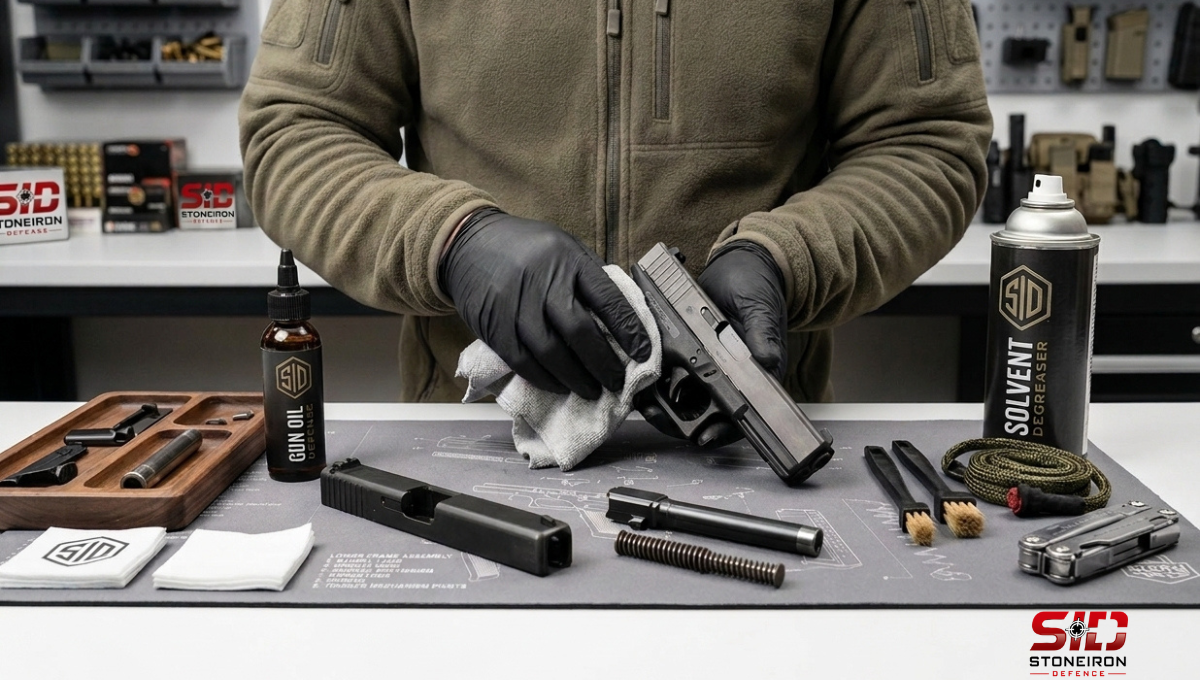
Using improper tools—such as harsh household chemicals or abrasive metal wire—can permanently strip protective coatings and damage internal tolerances. Building a dedicated kit with specialized gear ensures smooth maintenance.
| Maintenance Tool / Solvent | Primary Function | Why It Matters |
|---|---|---|
| Bore Snake / Cleaning Rod | Barrel residue removal | Clears carbon build-up without scratching rifle lands or grooves. |
| Solvent (Degreaser) | Carbon & copper breakdown | Dissolves stubborn fouling inside high-heat zones. |
| Gun Oil / CLP | Friction reduction & protection | Prevents metal-on-metal wear and guards against rust. |
| Nylon Detail Brushes | Recessed area scrub | Reaches slide rails, trigger groups, and bolt faces safely. |
| Lint-Free Microfiber Cloths | Surface wipe-down | Leaves no fabric fibers inside action assemblies. |
At STONEIRON DEFENSE LLC, we recommend maintaining high-grade cleaning components that do not degrade under chemical exposure.
3. Step-by-Step Cleaning and Maintenance Process
Cleaning your firearm does not require a complete armor-level teardown every single week. Field stripping—disassembling the platform into its primary component groups—is sufficient for routine long-term care.
Step A: Field Stripping
Follow your manufacturer’s guidelines to separate the firearm into its core components:
- Pistols: Frame, slide, barrel, recoil spring assembly.
- Rifles (AR-15 / Carbines): Upper receiver, lower receiver, bolt carrier group (BCG), charging handle.
Step B: Barrel and Bore Care
The barrel endures extreme pressure, heat, and bullet jacket friction.
- Apply a quality bore solvent down the barrel and allow it to sit for 3–5 minutes to break down carbon and copper buildup.
- Push a brass or nylon bore brush from the chamber to the muzzle (always follow the direction of bullet travel to protect the muzzle crown).
- Pass clean cotton patches through until they exit completely white and dry.
- Run a lightly oiled patch through the bore to deposit a micro-thin protective barrier against internal corrosion.
Step C: Receiver, Slide, and Frame Cleaning
Fouling collects heavily along guide rails, bolt faces, and locking lugs.
- Spray a small amount of solvent onto a nylon brush.
- Scrub the slide rails, breech face, extractors, and locking blocks.
- Wipe down all loosened sludge using a clean microfiber cloth.
- Inspect internal springs and pins for metal burrs, excessive wear, or cracks.
4. Proper Lubrication: Where, How Much, and What to Avoid
Over-lubrication is one of the most common mistakes firearm owners make. Excess oil acts like a magnet for unburnt gunpowder, dust, and sand, turning into an abrasive slurry that slows down cycle times and causes feeding failures.
Key Lubrication Points
- Slide Rails & Frame Tracks: Apply one small drop of gun oil per side and spread evenly.
- Barrel Exterior & Hood: Apply a light film where metal rubs against the slide during cycling.
- Bolt Carrier Group (BCG): Lightly coat the friction points, cam pin, and bolt head.
- Trigger Mechanism: Apply a tiny drop on pivot points; avoid drenching the assembly.
The Golden Rule of Lubrication: If oil is actively dripping, running, or pooling inside the frame, you have applied too much. Wipe away excess liquid until a thin sheen remains on high-friction surfaces.
5. Component Inspection and Preventive Replacement
Preventive maintenance is about replacing worn parts before they fail at the range or in the field. Every mechanical component has a finite operational lifespan measured in round counts.
| Firearm Component | Typical Lifespan (Rounds) | Signs of Wear / Inspection Method |
|---|---|---|
| Recoil Springs | 3,000 – 5,000 | Failure to return fully into battery; sluggish cycling. |
| Extractor & Springs | 5,000 – 10,000 | Failures to extract (FTE); chipped extractor claw edge. |
| Gas Rings (AR Platforms) | 3,000 – 5,000 | Bolt falls under its own weight when stood upright on bolt face. |
| Firing Pin / Striker | 10,000+ | Light primer strikes; chipped tip or surface pitting. |
| Magazine Springs | Variable | Failure to feed (FTF); loose tension on the final rounds. |
When replacing components, ensure you source precision-engineered parts built to exact tolerances. STONEIRON DEFENSE LLC supplies high-grade firearm components and tactical accessories built for heavy-use environments.
6. Long-Term Storage and Environmental Protection
Proper cleaning is useless if your firearm rusts inside a storage safe. Ambient moisture, humidity, and atmospheric salt can ruin metal finishes within weeks.
Best Practices for Storage
- Humidity Control: Keep your gun safe between 30% and 50% relative humidity. Use a golden rod heater or rechargeable silica gel desiccant canisters to draw moisture out of the air.
- Avoid Soft Cases for Long Storage: Soft fabric or foam cases trap moisture directly against the metal finish, accelerating rust formation. Use open-air racks or micro-VCI storage bags instead.
- Wipe Down Surfaces: Fingerprint oils contain natural acids that etch into steel bluing and coatings. Always wipe down exterior metal surfaces with a silicone-treated cloth before closing the safe.
- Magazine Care: Store magazines in cool, dry conditions. Periodically disassemble and clean dust out of magazine bodies to maintain smooth follower travel.
7. Establishing a Routine Maintenance Schedule
Consistency prevents surprises. How often you clean depends on your usage frequency:
- Post-Range Duty: Perform a light field strip, bore scrub, rail wipe, and re-lubrication after every shooting session.
- Carry Firearms (Concealed / Duty): Inspect weekly. Dust bunnies and lint accumulate inside holsters; blow out debris and refresh lubrication monthly, even if unfired.
- Deep Maintenance (5,000 Rounds): Detail strip the slide and trigger group, thoroughly degrease all internal channels, inspect small spring tensions, and replace worn gas rings or recoil assemblies.
The STONEIRON DEFENSE Commitment
Taking care of your gear ensures that your gear takes care of you. Firearm longevity comes down to disciplined habits: safe handling, thorough cleaning, deliberate lubrication, and quality replacement parts.
At STONEIRON DEFENSE LLC, we are dedicated to supporting shooters, enthusiasts, and defense-minded individuals with reliable technical knowledge, top-tier firearm components, and rugged tactical gear. Explore our catalog today to keep your equipment running at peak performance.