
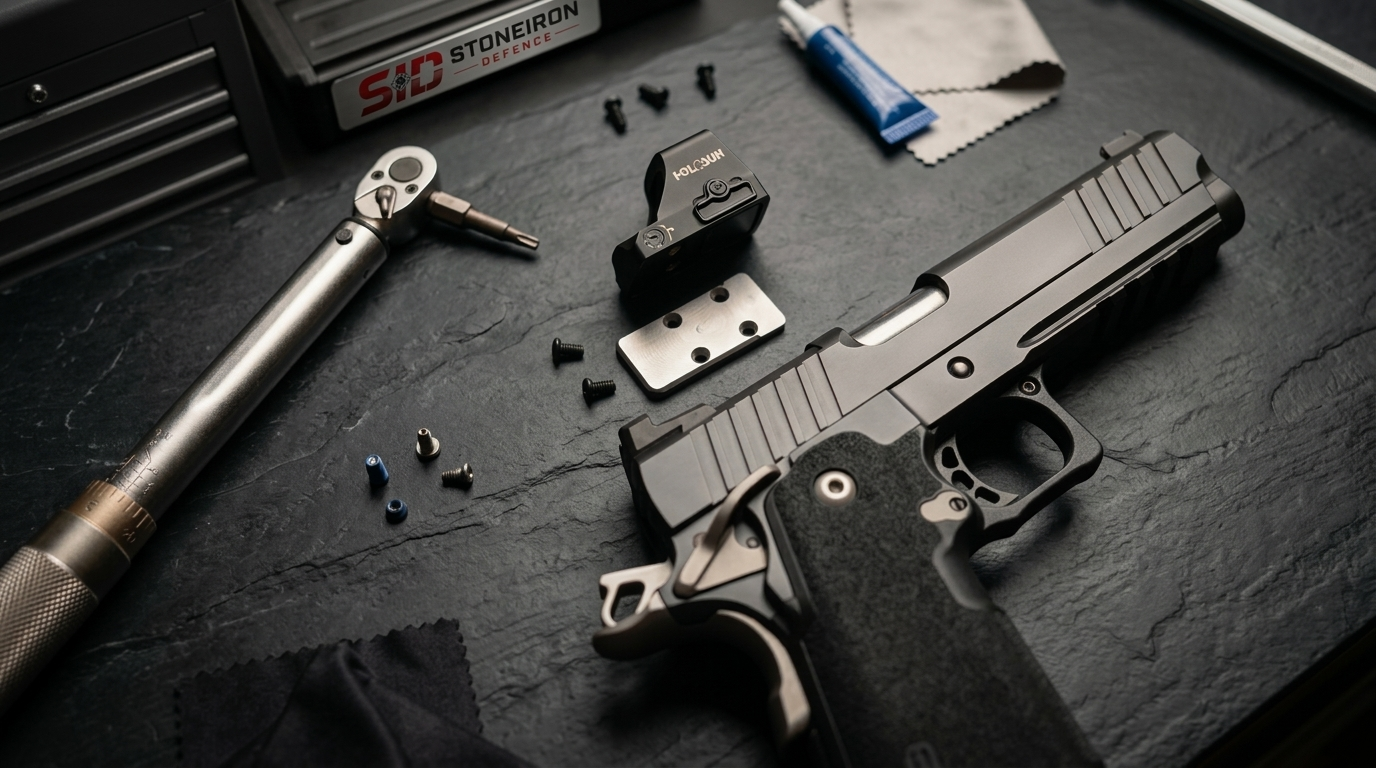
Holosun 407K Prodigy Plate: Specs & Co-Witness Guide
Sep 21st 2026
The Springfield Prodigy 9mm DS has an AOS (Agency Optic System) mounting cut, but it doesn't accept a Holosun 407K directly. To run a 407K on your Prodigy, you'll need the correct adapter plate. This guide covers plate selection, compatibility verification, proper installation torque, and troubleshooting so you can mount your optic confidently.
Whether you're building a competitive pistol, duty gun, or carry setup, getting the mounting right matters. A loose optic—or worse, one that drifts zero—isn't acceptable. This article covers what you need to know before you buy, how to install it correctly, and how to verify everything is secure.
Will the Holosun 407K Fit the Springfield Prodigy?
Not directly. The Holosun 407K uses the K-series footprint (a modified RMSc pattern). The Springfield Prodigy AOS cut requires an adapter plate to accept K-series optics.
Compatibility Matrix
| Component | Specification |
|---|---|
| Firearm | Springfield Prodigy (all AOS-cut models) |
| Optic | Holosun 407K / 407K-X2 / 407K-GR |
| Optic Footprint | K-series (modified RMSc) |
| Plate Required | Yes—K-series adapter plate for AOS cut |
| Plate Torque Spec | 15 in-lbs (plate to slide) |
| Optic Torque Spec | 15 in-lbs (optic to plate) |
| Rear Sight/Co-Witness | Depends on plate model (see section below) |
| Manufacturers | C&H Precision, EGW, Freedom Gorilla, Impact CNC |
Note: If your Prodigy is NOT AOS-cut (original Prodigy models without optic mounting), you'll need slide milling or a different firearm.
Understanding the Holosun 407K Footprint
The Holosun 407K is not compatible with standard RMR cuts—a common source of confusion.
K-Series Footprint Details:
- Two front locating pins (17mm apart)
- Two rear mounting screws (14mm apart)
- Mounting screws: typically M3 or #6-32 thread, included with the optic
- Torque specification: 15 inch-pounds
- Optics sharing this footprint: 407K, 507K, EPS, EPS Carry
RMR Footprint (Different—Not Compatible with 407K):
- Includes rear locating pins (which the K-series lacks)
- Requires RMR-specific plates
- Optics: 407C, 507C, 509T, RMR, SRO
Why This Matters:
If you order an RMR plate for your 407K, it won't fit. The K-series optic is missing the rear pins that RMR plates expect. You must verify your plate is explicitly rated for K-series optics.
The Springfield Prodigy AOS Cut Explained
The Prodigy's AOS (Agency Optic System) cut is machined into the slide to accept specific adapter plates. This cut doesn't directly accept any red-dot footprint—it's an interface for mounting plates.
What This Means for the 407K:
An AOS-cut Prodigy requires an adapter plate that converts the AOS mounting surface to a K-series footprint. The plate sits between the slide and your optic, transferring torque and alignment.
AOS-Compatible Plates for 407K:
- C&H Precision Prodigy to Holosun K Optic Plate: 6061 aluminum, MIL-SPEC Type III hard anodized
- EGW Holosun K Series Mount for Springfield Prodigy: 7075 aluminum, matte black hardcoat
- Freedom Gorilla DOGTAG Plate: Carbon steel, integrated rear sight for co-witness
- Impact CNC Machine RMR/507 Plate: Carbon steel, built-in rear sight, 6/48 to 6/32 conversion
Pro Tip: All reputable manufacturers specify 15 in-lbs of torque for plate-to-slide mounting on the Prodigy.
Does Your Plate Provide Co-Witness?
"Co-witness" is one of the most misunderstood terms in pistol optics. Here's what it actually means—and which plates offer it.
Definition:
Co-witness occurs when your iron sights align with your red-dot sight picture. When looking through the optic, you see your rear sight at the bottom of the lens, visible but not blocking the dot.
Co-Witness and the 407K:
Whether you can co-witness depends entirely on your specific plate and rear-sight setup—not on the 407K itself.
Types of Co-Witness:
- Lower 1/3 Co-Witness (most common): Rear sight appears in the lower third of the optic window, fastest backup aiming solution, requires suppressor-height or factory-height iron sights (depending on plate), many aftermarket plates support this.
- Absolute Co-Witness: Rear sight sits dead-center with the dot, less common, rarer with 407K plates, can partially obstruct the optic window.
- No Co-Witness: Optic height is too high for irons to be visible; backup irons require a separate solution (or omitted entirely), simpler to manufacture, but less redundant.
Important: Co-witness is NOT a failsafe for optic failure. If your red-dot fails, you still have irons—but co-witness simply means they're already visible and (if installed correctly) already zeroed to match your optic zero.
Plates with Integrated Rear Sights:
Some manufacturers (Freedom Gorilla, Impact CNC) build rear-sight dovetails directly into the plate for integrated lower-1/3 co-witness. This approach ensures your backup sight is rigidly attached to the mounting system, not the slide.
Plates Without Integrated Sights:
Most aluminum plates (C&H, EGW) don't include rear sights. If you want co-witness, you'll need to add suppressor-height iron sights separately.
Before buying: Verify whether the specific plate you're ordering includes an integrated rear sight or requires aftermarket irons for co-witness.
Holosun 407K Installation on Your Prodigy
Proper installation is straightforward if you follow the manufacturer's specifications exactly.
Tools Required:
- Torque wrench (0–25 in-lbs range, calibrated)
- Hex wrench set (T10 Torx for most 407K screws, or the specific driver included with your optic)
- Threadlocker (medium-strength, e.g., Loctite 243 or equivalent)
- Cleaning supplies (CLP, patch)
- Padded vise or gun cradle (optional but recommended)
Step-by-Step Installation:
1. Prepare and Clean
Remove the slide from the frame. Inspect the AOS mounting surface and threaded holes for dirt, corrosion, or damage. Clean thoroughly with CLP and a brush. Dry completely. Do NOT proceed if threads appear stripped or damaged.
2. Dry-Fit the Plate
Position the adapter plate onto the AOS mounting surface without fasteners. It should sit flush with zero rocking or gaps. If it rocks, the plate is misaligned or the slide has a machining issue. Contact the plate manufacturer or slide maker before proceeding.
3. Apply Threadlocker
Place a small drop of medium-strength threadlocker on each AOS mounting screw thread. Do not over-apply—excess threadlocker can migrate into screw holes and harden, making future removal difficult.
4. Install and Torque (Plate to Slide)
Install all plate-to-slide screws by hand, starting with a crisscross pattern (diagonal). Use your calibrated torque wrench to apply 15 in-lbs to each fastener. Do not exceed this value—over-torquing can strip threads or damage the slide.
Typical sequence:
- Tighten screw 1 (upper left) to 15 in-lbs
- Tighten screw 3 (lower right) to 15 in-lbs
- Tighten screw 2 (upper right) to 15 in-lbs
- Tighten screw 4 (lower left) to 15 in-lbs
- Verify each screw is at 15 in-lbs
5. Mount the Holosun 407K to the Plate
The 407K includes mounting screws (usually M3 flat-head with Torx T10 drive). Position the optic on the plate's K-series mounting interface. Verify the lens is clean and the optic is centered. Apply a small drop of threadlocker to the optic-mounting screws.
6. Torque the Optic Screws
Using your torque wrench, apply 15 inch-pounds to each optic-mounting screw. The 407K typically uses two screws. Do not exceed 15 in-lbs—excess torque can crack the optic lens housing.
7. Let Threadlocker Cure
Wait 24 hours before handling or shooting. Do not move the gun or adjust fasteners during this window. Threadlocker requires time to fully set.
8. Verify at the Range
Fire 10 rounds at 7 yards and check zero. If zero is stable, continue with confidence. If the dot has shifted noticeably, proceed to troubleshooting (see section below).
Torque Specifications—The Critical Detail
This is the most common installation error: using incorrect torque values.
Why Torque Matters:
- Under-torque (< 15 in-lbs): Screws can loosen under recoil, causing optic shift or creep.
- Over-torque (> 15 in-lbs): Screws strip, optic lens housing cracks, fasteners seize.
The Specification:
For Holosun 407K installation on a Springfield Prodigy AOS plate:
| Interface | Fastener Torque | Notes |
|---|---|---|
| Plate to Slide | 15 in-lbs | Standard AOS spec; do not vary |
| Optic to Plate | 15 in-lbs | Holosun 407K standard; use T10 Torx driver |
| Threadlocker | Medium-strength (243/242) | Blue Loctite; avoid red or excessive application |
Important Caveat: Different manufacturers and different optics may specify different torque values. Always consult the documentation for your specific plate and optic. If you have conflicting specifications, use the lower value.
How to Use a Torque Wrench:
- Set the desired value (15 in-lbs for this application)
- Apply steady pressure—do not jerk or shock-load
- Stop when you hear/feel the wrench click or slip
- Do not force past the click
Verifying Torque:
After 50 rounds, re-check each fastener with your torque wrench to confirm it's still at spec. This is especially important with a new threadlocker. Do this again after 500 rounds.
Troubleshooting—Why Your Optic Might Lose Zero
Problem: Optic drifts after installation
Likely causes and solutions:
- Threadlocker not fully cured: Wait 24 hours before shooting. Even a blue threadlocker needs time.
- Insufficient torque: Re-torque all fasteners to 15 in-lbs. If the torque spec was too low initially, the plate may have migrated under recoil. Use a calibrated torque wrench; home wrenches drift over time.
- Plate not seated flush on slide: Remove plate. Inspect AOS mounting surface for debris, burrs, or machining variance. If plate rocks when dry-fit, contact manufacturer—the plate or slide may have a tolerance issue.
- Incorrect threadlocker or excessive application: Remove fasteners, clean threads thoroughly with alcohol, reapply a small amount of fresh threadlocker, and re-torque.
- Damaged or stripped screw holes: Inspect screw holes for thread damage. If threads are compromised, the plate cannot hold torque. If holes are stripped, a gunsmith can re-tap to the next size up (usually not practical for the slide itself).
- Optic damaged: Less common, but possible: The 407K lens could be damaged, causing reticle movement or internal component shift.
Problem: Fasteners keep loosening
- Verify correct threadlocker type: Blue Loctite (243/242) is appropriate for this application. Red Loctite (271) is too strong and makes removal nearly impossible; avoid for pistol optics.
- Check for under-torque: Confirm your torque wrench is calibrated. Many home wrenches lose calibration after 2 years. Set to exactly 15 in-lbs and verify each screw.
- Inspect for galling (metal-to-metal scoring): Galling occurs when screw threads seize to the tapped hole, causing incomplete thread engagement.
- Prevention: Apply a tiny amount of anti-seize grease to fastener threads (though this can reduce holding force; use sparingly). If galling has occurred: Remove fasteners, clean threads, and install fresh screws.
- Consider stronger threadlocker as a last resort: If fasteners continue to loosen after proper torque and fresh threadlocker, medium-strength threadlocker (243) should be sufficient. If not, the underlying cause (stripped threads, incorrect plate fit, under-torque) likely remains unsolved. Do not simply jump to red threadlocker without addressing the root cause.
Material Considerations—Aluminum vs. Steel Plates
Many manufacturers offer optic plates in both aluminum and steel. The choice involves trade-offs.
Aluminum Plates (6061, 7075 Alloy)
Advantages:
- Lightweight
- Lower cost
- Widely available from established manufacturers (C&H, EGW)
- Suitable for typical carry and range use
Disadvantages:
- Softer threads that can strip if over-torqued
- Greater thermal expansion than steel (may affect zero across temperature extremes)
- Thread strength lower than steel
Real-world performance: Aluminum plates from reputable CNC manufacturers with proper hard coating (MIL-SPEC Type III anodize) hold zero reliably when installed and torqued correctly. User reports document thousands of rounds through aluminum plates without failure. Cost of replacement is reasonable if thread damage occurs.
Steel Plates (Carbon Steel, Heat-Treated)
Advantages:
- Harder threads, more resistant to stripping
- Lower thermal expansion
- Higher thread strength
- Perceived as more robust
Disadvantages:
- Heavier
- More expensive
- Fewer readily available options for Prodigy-specific applications (some manufacturers offer them, but selection is limited)
Real-world performance: Steel plates hold zero reliably. Steel's advantage is primarily thread durability over repeated installations/removals and resistance to thermal expansion. For a plate installed once and left in place, the practical difference between quality aluminum and steel is minimal.
Bottom Line:
For a Prodigy-mounted 407K, a quality aluminum plate from C&H or EGW installed correctly will not fail under normal carry, competition, or range use. If you plan to frequently mount and remove the optic, steel's thread durability is an advantage. If cost and weight are considerations, aluminum is adequate.
Note: Do not conflate material alone with quality. A poorly machined steel plate is worse than a well-machined aluminum plate. Verify CNC tolerances, hard coating (anodize for aluminum), and manufacturer reputation regardless of material choice.
Slide Milling vs. Adapter Plate—Which Is Right for You?
Both approaches are valid. The choice depends on your use case, budget, and future flexibility.
Direct Slide Milling (AOS or Custom Optic Cut)
How it works: A gunsmith mills the slide to accept a specific optic footprint directly (e.g., K-series). The optic mounts flush to the slide; no adapter plate is needed.
Advantages:
- Lowest possible sight height
- Cleaner aesthetics (no plate interface)
- Permanent mounting (simple and unified)
Disadvantages:
- Irreversible—the slide is permanently modified
- Requires a gunsmith ($150–400 depending on work)
- Re-finishing milled areas introduces corrosion risk if not done correctly
- Reduces slide resale value
Adapter Plate Mounting
How it works: An AOS plate converts the Prodigy's AOS mounting surface to K-series (or another footprint). The optic mounts to the plate, which mounts to the slide.
Advantages:
- Non-permanent—can be removed or swapped for a different footprint
- No gunsmith required; DIY installation with standard tools
- Preserves slide value (can sell as AOS-only if desired)
- Faster to configure (order plate, install same day)
- Easier to troubleshoot if issues arise
Disadvantages:
- Slight height increase over milling (typically 0.15–0.2 inches; negligible for handling)
- Adds complexity (plate as an additional component)
- Requires periodic torque verification
When to Choose Milling:
- You plan to own the Prodigy permanently without selling
- Lowest sight height is a priority (e.g., minimizing snag hazard on a carry gun)
- You have access to a trusted gunsmith or factory service
- You want a unified, single-piece design
When to Choose an Adapter Plate:
- You value flexibility (potential to swap footprints, sell the gun, or experiment)
- You want to avoid gunsmith costs
- You prefer reversibility
- You want integrated co-witness features (via integrated rear-sight plates)
For most shooters: An adapter plate is the practical choice. You get 99% of the functionality of milling at a fraction of the cost and with more flexibility.
Installation Verification Checklist
Before you take your gun to the range, confirm:
Before Assembly:
- Plate is rated for Holosun K-series (NOT RMR)
- Plate is rated for Springfield Prodigy AOS cut
- You have the correct mounting screws (included with optic and/or plate)
- Torque wrench is calibrated (check manufacturer specs if over 2 years old)
- Threadlocker is medium-strength (Loctite 243/242 or equivalent)
During Installation:
- Slide is clean and dry
- Plate dry-fits flush to AOS surface with no rocking
- All fasteners are torqued to exactly 15 in-lbs in a crisscross pattern
- Optic mounting screws are torqued to exactly 15 in-lbs
- Threadlocker has cured for 24 hours before shooting
At the Range (First Session):
- 10 rounds at 7 yards; zero is stable
- 50 rounds total; no optic shift
- Re-torque all fasteners with a torque wrench (confirm 15 in-lbs)
At the Range (Later Sessions):
- After 500 rounds: Re-verify all fasteners
- After 1000 rounds: Visual inspection for looseness or damage
- Monthly: Quick visual check for creep or gaps
Frequently Asked Questions
Will a Holosun 407K fit directly on a Springfield Prodigy without an adapter plate?
No. The Prodigy's AOS mounting cut requires an adapter plate to accept the 407K's K-series footprint. The AOS cut is designed for removable, universal plates—not for direct optic mounting. You must purchase a K-series adapter plate rated for the Prodigy.
What's the difference between the Holosun 407K and 507K?
They use the same K-series footprint and are dimensionally identical. The main difference is the reticle: the 407K has a simple 6 MOA red dot; the 507K adds a 32 MOA circle around the dot. Functionality and mounting are identical. Both work with the same Prodigy adapter plates.
Does the 407K come with screws, or do I need to buy them separately?
The 407K comes with a set of mounting screws in the box. Most adapter plates also include screws for mounting the plate to the slide. Verify that screw counts and sizes match before installation. If screws are damaged, replacement screws are widely available (typically M3 or #6-32).
What torque should I use for the Holosun 407K?
Use 15 inch-pounds for mounting the optic to the adapter plate. Use 15 inch-pounds for mounting the plate to the slide. Always consult your specific plate manufacturer's documentation if they specify a different value, and use the lower specification if there's a conflict.
Can I install the plate myself, or do I need a gunsmith?
You can install the plate yourself with basic tools: a torque wrench, hex wrenches, and threadlocker. Follow the step-by-step installation section above. If you're uncomfortable working on firearms, a gunsmith can install it for $50–150. The critical step is torquing to specification; rushing or guessing can cause problems.
My optic drifted zero after a few shots. What went wrong?
The most likely cause is insufficient torque or incomplete threadlocker cure. Stop shooting, allow 24 hours for threadlocker to fully set, then re-torque all fasteners to 15 in-lbs. If zero shifts again after re-torque, the plate or slide may have a fitment issue (see troubleshooting section). Do not continue shooting until you've identified the cause.
Does my 407K setup provide co-witness with iron sights?
Co-witness depends on your specific plate and rear-sight configuration, not on the 407K itself. Some plates (Freedom Gorilla DOGTAG, Impact CNC) include integrated rear sights for lower-1/3 co-witness. Most aluminum plates (C&H, EGW) do not include rear sights; if you want co-witness, add suppressor-height iron sights separately. Verify your plate's co-witness capability before purchasing.
Can I use the same plate for both a 407K and a 507K?
Yes. Both the 407K and 507K use the K-series footprint and are dimensionally identical. Any K-series adapter plate for the Prodigy will accept either optic.
Maintenance & Inspection
Monthly:
- Visually inspect all fasteners for gaps or creep
- Wipe the optic lens with a microfiber cloth (no solvents on the lens itself)
- Check for carbon buildup around the lens edges
Every 500 Rounds:
- Disassemble the slide
- Use a brush and CLP to clean the plate and mounting surfaces
- Re-torque all fasteners to 15 in-lbs
- Inspect the optic lens for internal dust or damage
Annually (or After Heavy Use):
- Remove the optic from the plate completely
- Inspect the gasket seal (if present) for wear or degradation
- Clean the optic mounting interface on the plate
- Reinstall with fresh threadlocker (replace old residue if possible)
- Verify all fasteners at 15 in-lbs
When to Replace:
- Visible stress cracks or damage to the plate
- Screw holes no longer hold torque spec (usually indicates galling or thread damage)
- Optic lens is cracked or has internal fungus
- Persistent loosening despite correct torque and threadlocker (indicates underlying fitment issue)
Key Takeaways
- Compatibility first: The Holosun 407K requires a K-series adapter plate for the Springfield Prodigy AOS mounting system. Direct mounting is not possible.
- Torque specs matter: 15 in-lbs is the standard for both plate-to-slide and optic-to-plate fasteners. Use a calibrated torque wrench; do not guess.
- Threadlocker is essential: Medium-strength threadlocker (Loctite 243) is standard. Allow 24 hours for cure before shooting.
- Co-witness is plate-specific: Not all plates provide integrated rear sights. Verify your plate's co-witness configuration before purchase if backup sights matter to you.
- Installation is DIY-friendly: With the right tools and adherence to torque specs, installation is straightforward.
- Verify early and often: Check zero after the first 10 rounds, re-torque after 50, and inspect regularly. Early detection of problems prevents damage.
- Material quality varies: Both aluminum and steel plates from reputable manufacturers hold zero reliably. The key is proper machining tolerance, hard coating (for aluminum), and adherence to torque specifications.
- Slide milling vs. plates: Adapter plates offer more flexibility; milling offers the lowest sight height. Both are valid. Plates are faster to implement and reversible.