
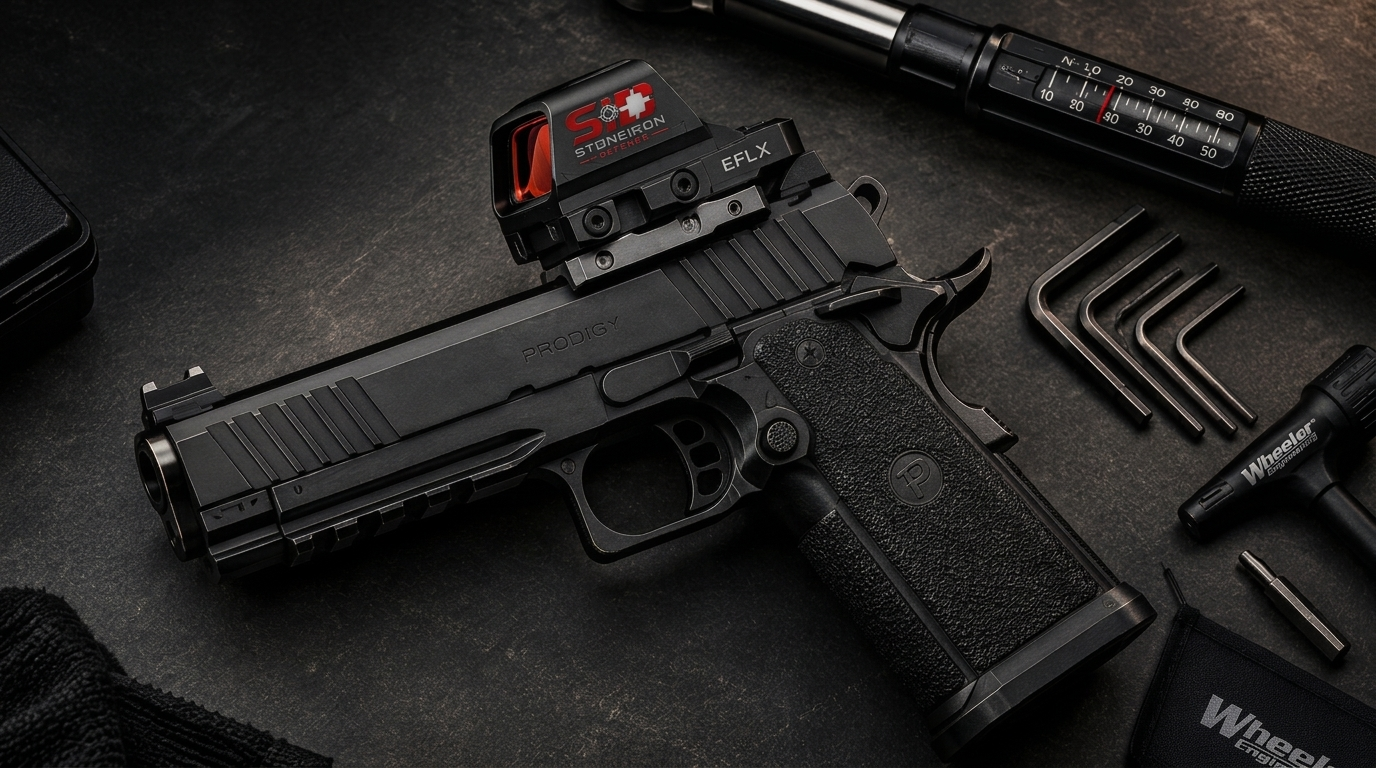
EOTech EFLX: Footprint, Specs & Springfield Prodigy Mounting
Sep 22nd 2026
The EOTech EFLX is a large-window reflex sight designed for pistol shooters and as a secondary optic on magnified rifle systems. For Springfield Prodigy owners, the key question isn't whether the EFLX can mount to the pistol—it can—but how, and whether it makes sense for your specific setup and intended use.
This guide covers what the EFLX actually is, its footprint and specifications, compatibility with the Prodigy's Agency Optic System (AOS), mounting considerations, and how it compares to alternative optic solutions.
What Is the EOTech EFLX?
The EFLX is a reflex sight featuring a large 26mm window. Unlike compact micro red dots that prioritize low profile, the EFLX's larger window trades some compactness for increased sight picture size, making target acquisition faster in dynamic shooting scenarios.
The optic is constructed with a solid aluminum housing and uses a proven reflex design. It's weatherproof and built to tolerate the recoil and handling that modern pistol shooters demand.
EOTech EFLX Specifications
| Specification | Detail |
|---|---|
| Type | Pistol reflex sight |
| Mounting Footprint | Leupold DeltaPoint Pro |
| Reticle Options | 3 MOA and 6 MOA dots |
| Battery | CR2032 |
| Battery Access | Top-loading |
| Adjustment | 1 MOA per click |
| Weight | Approximately 1.4 oz (35 g) |
| Dimensions | Approximately 1.9 × 1.2 × 1.0 inches |
| Window Size | 26mm |
Specifications based on EOTech product documentation. Consult the manual for complete details specific to your model.
What Footprint Does the EOTech EFLX Use?
The EOTech EFLX uses the Leupold DeltaPoint Pro footprint.
This is the critical compatibility specification. The footprint determines which mounting plates and adapters will physically work with the optic. The DeltaPoint Pro footprint is well-established in the firearms accessory market, which means compatible mounting solutions exist for most common platforms—including the Springfield Prodigy.
When shopping for EFLX mounting plates, you're specifically looking for plates designed for the DeltaPoint Pro footprint that also fit your specific pistol's mounting system.
EOTech EFLX and Springfield Prodigy Compatibility
The Springfield Prodigy doesn't lack optic-mounting capability. Rather, it's designed around Springfield's Agency Optic System (AOS), which uses interchangeable mounting plates as the optic interface rather than permanent modifications to the slide.
Here's how the compatibility chain works:
Prodigy (AOS-compatible) → DeltaPoint Pro-compatible AOS plate → EOTech EFLX
To mount an EFLX on a Prodigy, you need an AOS-compatible mounting plate that also provides the DeltaPoint Pro footprint. This plate acts as a bridge between the Prodigy's mounting interface and your optic.
The short answer: Yes, an EOTech EFLX will fit a Springfield Prodigy—provided you use the correct AOS plate designed for the DeltaPoint Pro footprint.
Springfield Prodigy AOS Mounting Options
Understanding your mounting options helps you choose the right solution for your needs and budget.
Aftermarket AOS Plates (Most Common)
Aftermarket manufacturers produce AOS-compatible plates that accept DeltaPoint Pro-footprint optics. These plates bolt directly to the Prodigy's AOS interface. When selecting a plate, verify:
- Compatibility with DeltaPoint Pro footprint
- Proper fastener specifications
- Whether the plate includes integrated rear-sight channels
- Material and construction quality
- Manufacturer installation documentation
Examples of aftermarket options include manufacturers like StoneIron Defense (SID), which offers 4140 steel AOS plates with integrated rear-sight functionality.
Direct Milling
Some shooters opt to send their slide to a gunsmith for permanent milling of a DeltaPoint Pro optic cut. This is irreversible and typically results in a lower optic position. It may affect your warranty coverage depending on manufacturer terms, so confirm the manufacturer's warranty policy before proceeding. Direct milling makes sense only if you're committed to a specific optic footprint and want the lowest possible sight height.
Dovetail Adapters
Rear-dovetail adapters mount to the Prodigy's rear sight dovetail instead of the AOS interface. These are often lower-profile than AOS plates but may provide less surface contact. They're a budget option if you want minimal height or are using a Prodigy without an AOS interface, though most modern Prodigies include AOS.
StoneIron Defense (SID) and EFLX Mounting
StoneIron Defense (SID) manufactures aftermarket AOS-compatible mounting plates for the Springfield Prodigy. Their plates are CNC-machined from 4140 stress-relieved steel and feature integrated rear-sight channels, allowing shooters to maintain co-witness alignment without separate backup-sight adapters.
When evaluating any AOS plate—including StoneIron Defense (SID) options—compare:
- Material and construction quality
- Compatibility verification with your specific plate and optic
- Manufacturer's torque specifications
- Installation documentation
- Integrated features (rear-sight channels, etc.)
- Price and warranty
StoneIron Defense (SID) is one example of an available solution; other manufacturers also produce compatible AOS plates. Your choice depends on your specific needs and budget.
4140 Steel vs. Aluminum Optic Plates
This discussion matters because mounting-plate material affects durability and performance characteristics.
4140 Steel is chromoly tool steel—stronger and more rigid than aluminum. Stress-relieved 4140 resists deflection and maintains thread integrity through repeated installation/removal cycles. It's heavier than aluminum and more expensive to machine. A well-designed steel plate can maintain dimensional accuracy across temperature changes and sustained use.
6061 Aluminum is lighter and faster to machine, making it more affordable. Aluminum conducts heat effectively and resists corrosion. However, aluminum is softer than steel and more susceptible to thread stripping if fasteners are over-tightened or if the design is marginal.
The real factors in optic-mount performance:
Plate geometry, surface finish, fastener design, proper installation torque, and stability of the mounting interface matter as much as material selection. A well-engineered aluminum plate can outperform a poorly designed steel plate. A precision-machined steel plate offers additional durability margins, particularly for high-volume shooters.
General principle: Competitive shooters and users putting thousands of rounds through their pistols may benefit from steel's extra durability margin. Recreational shooters using quality ammunition through a well-designed aluminum plate will find reliable performance.
EFLX vs. EFLX CE
EOTech manufactures two distinct EFLX product lines with different designs and features.
EOTech EFLX (Standard)
The standard EFLX is an open-top reflex sight with the DeltaPoint Pro footprint. It features a 26mm window and comes in 3 MOA or 6 MOA reticle options. It's designed primarily as a pistol optic and can serve as a secondary optic on magnified rifle setups.
EOTech EFLX CE
The EFLX CE is a substantially different product. It features a fully enclosed design with integrated rear backup iron sights built into the optic itself. The EFLX CE uses multiple mounting footprint options and adds shake-awake technology and multi-dot reticle capability. Its design philosophy is different—it's a self-contained sight system rather than an open-window reflex.
For someone mounting an optic to a Springfield Prodigy using an AOS plate, the standard EFLX is typically the relevant choice. The EFLX CE's integrated rear sights and enclosed design serve a different market segment.
Verify which EFLX variant you're actually purchasing or using, as they're distinctly different products with different mounting compatibility.
How to Mount the EOTech EFLX
Before bolting anything down, verify that you have the correct mounting plate and hardware. Installation quality directly affects zero retention and overall reliability.
Pre-Installation Verification
- Confirm the plate is designed for both the Prodigy's AOS interface and the DeltaPoint Pro footprint
- Use fasteners specified by the plate manufacturer—do not substitute with generic bolts
- Clean the mounting surface thoroughly to remove oils and debris
- Locate the manufacturer's installation documentation and torque specification
Torque Specification
This is critical. Follow the torque specification provided by the plate manufacturer for your specific mounting system. Different plates, fasteners, and thread engagements have different requirements. Do not use a generic or estimated torque value.
If the manufacturer doesn't provide a written specification, contact them before proceeding. Using a calibrated inch-pound torque driver ensures accurate fastener tension.
Installation Steps
- Position the mounting plate on the Prodigy's AOS interface, aligning all mounting holes
- Insert fasteners and hand-tighten to ensure proper alignment
- Using your torque driver set to the manufacturer's specification, tighten each fastener gradually in a cross pattern (similar to wheel-lug installation)
- Once tightened, do not over-torque
- Mount your EFLX to the plate according to EOTech's instructions
- Before relying on the setup, verify zero at the range
Co-Witness Considerations
Co-witness means your backup iron sights and red dot share the same sight picture or focal plane.
Why It Matters
If your optic fails or loses power, you still have usable backup sights. This is a reliability advantage for shooters who depend on their iron sights as a fallback.
Co-Witness Height Depends On:
- Your chosen mounting plate
- Optic height
- Rear sight height
- Front sight height
- How these components interact on the specific Prodigy configuration
An AOS plate with integrated rear-sight channels (like those offered by some manufacturers) can provide co-witness by design. Standard AOS plates without milled sight channels won't accommodate a rear sight without additional adapters.
Verify Before Purchasing
If co-witness alignment is important to you, check the exact specifications of the plate you're considering. Ask the manufacturer what co-witness configuration the plate provides with your optic and sights. This prevents trial-and-error adjustments after purchase.
Zero Retention and Mounting Stability
A precision-mounted optic should hold its zero reliably. Several factors work together to make this happen—none of them guaranteed by material alone.
What Affects Zero Retention:
- Proper fastener torque (too loose: movement; too tight: potential component damage)
- Quality of the mounting interface between plate and slide
- Quality of the mounting interface between optic and plate
- Surface contact area and cleanliness
- Fastener design and material
- Plate geometry and structural rigidity
- Installation quality
How to Inspect for Problems:
After mounting, periodically check that mounting fasteners haven't loosened. You can sometimes detect loose fasteners by gentle pressure on the plate or optic—any shift indicates a problem requiring attention. Before attributing a zero shift to a failing optic, inspect all fasteners and mounting interfaces.
Testing Zero Retention
Fire deliberately: shoot at least 50 rounds through your Prodigy at normal pace, then add another 50 at faster speed if that's how you'll use it. Conduct a zeroing session and document your point-of-impact. If your point-of-impact shifts meaningfully during use, inspect the mounting system for loose fasteners, inadequate surface contact, or installation errors before assuming the optic is defective.
Any unexpected point-of-impact shift should prompt inspection of fasteners, plate-to-slide fit, optic-to-plate fit, and installation quality.
EOTech EFLX vs. Smaller Micro Red Dots
The EFLX is not the same category as compact optics like the Trijicon RMR or Holosun EPS. The EFLX is a larger, open-window reflex sight designed to prioritize sight picture size over compactness.
Choose an EFLX if:
- You want a large sight window for rapid target acquisition
- You're willing to accept the added profile that an AOS plate introduces
- You plan pistol-centric shooting where target speed matters
- You prefer a reflex-sight design
Consider alternatives if:
- You prioritize concealability or minimal profile
- You want the lowest possible sight height
- You prefer compact micro red dots
- You're doing precision-focused shooting where sight picture size matters less than accuracy
Frequently Asked Questions
What footprint does the EOTech EFLX use?
The Leupold DeltaPoint Pro footprint. This mounting standard determines which plates and adapters are compatible.
Will an EOTech EFLX fit a Springfield Prodigy?
Yes, if you use an AOS-compatible mounting plate designed for the DeltaPoint Pro footprint. The Prodigy won't natively accept an EFLX—you need the intermediary AOS plate.
What AOS plate works with the EFLX on a Prodigy?
Any AOS plate designed for DeltaPoint Pro footprint optics will work. Examples include aftermarket options from manufacturers like StoneIron Defense (SID). Always verify compatibility with the plate manufacturer before purchasing.
What torque should I use when mounting an EFLX?
Follow the torque specification provided by your plate manufacturer for the specific fasteners and mounting system. Do not use a generic value. Torque specifications vary based on fastener size, material, thread engagement, and mounting interface. Your plate's documentation should specify the exact torque for your setup.
Can I directly mill my Prodigy's slide for an EFLX?
Yes, a competent gunsmith can mill a DeltaPoint Pro cut into the slide. This is permanent and irreversible. Before proceeding, confirm your warranty implications with Springfield Armory, as modification policies vary by manufacturer.
What's the difference between EOTech EFLX and EFLX CE?
The standard EFLX is an open-window reflex sight. The EFLX CE is a substantially different product featuring a fully enclosed design, integrated rear backup sights, and multiple mounting footprint options. They're different product lines serving different needs.
Can I keep my rear iron sights with an EFLX on my Prodigy?
It depends on your chosen plate. AOS plates with integrated rear-sight channels allow you to retain backup irons. Standard AOS plates without milled sight channels won't accommodate them without additional adapters. Verify this when selecting your plate.
Is a steel AOS plate better than aluminum?
Steel offers superior rigidity and thread durability, especially through repeated mounting cycles. Aluminum is lighter and adequate for most shooters. The choice depends on your use intensity (high round-count competition vs. recreational shooting) and budget. Plate design and installation quality matter as much as material.
What should I do if my zero shifts after mounting?
Inspect all mounting fasteners for tightness, verify that your plate sits flush against the slide, check the optic-to-plate interface, and confirm you followed the manufacturer's torque specification. Loose fasteners are the most common cause. If fasteners are tight and interfaces are clean and flush, the mounting system is likely sound, and the zero shift may indicate a different issue worth investigating.
Final Takeaways
The EOTech EFLX is a proven large-window reflex sight. On a Springfield Prodigy, it requires a compatible AOS plate designed for the DeltaPoint Pro footprint. The quality of your mounting system—its geometry, material, fastener design, and installation—directly affects how reliably your zero holds and how dependable the optic is under use.
For Prodigy owners, the practical decision is less about whether the EFLX can mount and more about which mounting solution makes sense for your intended use. If you're building a Prodigy for competitive shooting or dynamic training where a large optic window adds value, an EFLX with a quality AOS plate is a viable choice. If you prioritize a compact, low-profile solution, a micro red dot on a rear-dovetail adapter remains simpler and more affordable.
Choose your mounting solution deliberately, verify zero before trusting it in actual use, and follow the plate and optic manufacturer's installation requirements. Precision mounting systems reward precision installation.