How to Choose Firearm Components: Optic & Hardware Guide
Feb 13th 2025
Stepping into the world of firearm customization can quickly feel overwhelming. Whether you are setting up a home defense handgun, building a flat-shooting double-stack 1911, or configuring a precision rifle, the aftermarket catalog is massive.
Every manufacturer claims their components offer duty-grade reliability, match-grade accuracy, and unyielding performance. But when you start looking past the sleek anodized finishes, how do you actually determine which components will hold up under severe live-fire conditions?
At StoneIron Defense (SID), we believe true performance always starts with uncompromising material selection and exact engineering.
Upgrading a firearm isn't just about aesthetics or mounting modern optics. It is about understanding mechanical interfaces, material strength, and real-world compatibility. A single weak connection—like a cast aluminum adapter plate or an under-spec mounting screw—can lead to loss of zero, mechanical binding, or catastrophic hardware shear at the range.
In this comprehensive guide, we will break down the essential factors every shooter must evaluate when selecting firearm components. From navigating optic footprint compatibility to choosing the right metals for high-recoil platforms, here is what you need to know before investing your hard-earned money.
1. Material Selection: Cast Aluminum vs. Precision CNC 4140 Steel
The first and most critical decision when selecting firearm accessories is understanding material composition. Many factory-included accessories use low-cost polymer inserts, Metal Injection Molding (MIM), or soft 6061 aluminum. While these materials keep production costs low, they introduce flex and wear under sustained recoil.
When evaluating mounting systems, slide plates, or internal controls, consider how the metal handles repetitive kinetic energy and thermal cycles:
- 6061-T6 Aluminum: Lightweight and easy to machine, but soft. Threaded holes in aluminum can easily strip if torqued past 10–12 in-lbs. Under violent slide recoil, aluminum lugs deform over time, allowing microscopic slop.
- 7075-T6 Aluminum: Significantly stronger than 6061, offering better shear resistance. However, it still exhibits a different thermal expansion rate than steel slides, which can loosen screws during rapid-fire heating.
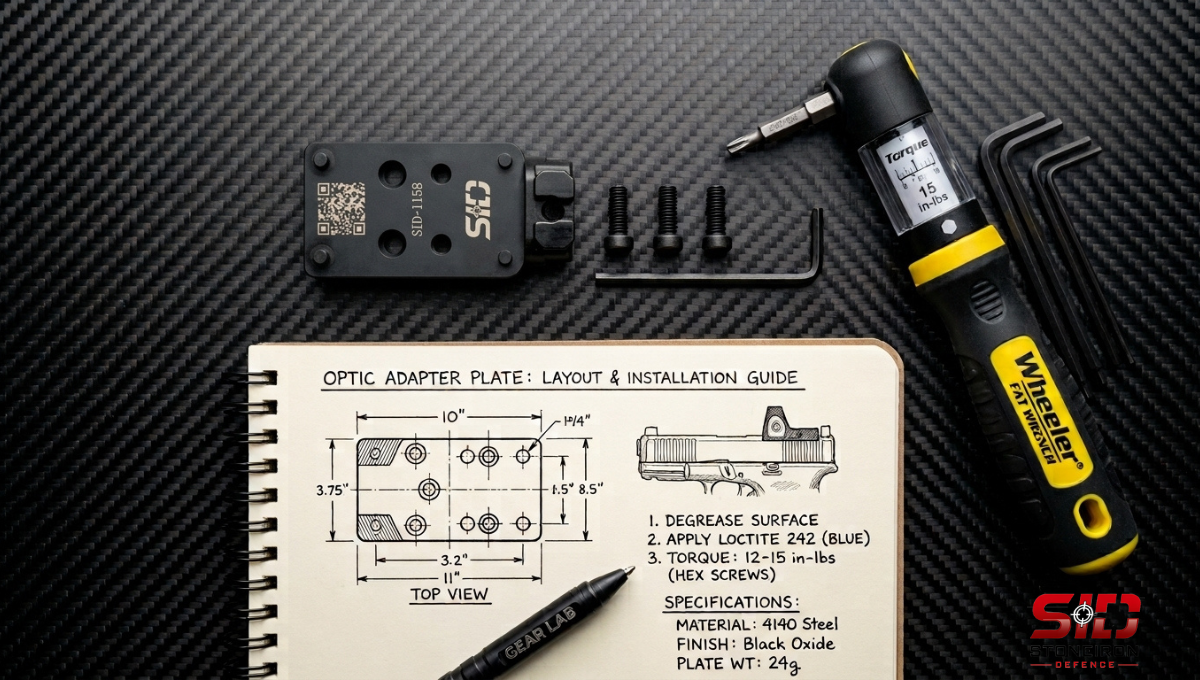
- CNC Machined 4140 Steel: The ultimate standard for high-stress interfaces. This is why engineering teams at StoneIron Defense (SID) build their optic plates exclusively from solid 4140 steel, ensuring high yield strength, matched thermal dynamics, and full torque security.
| Component Material | Structural Rigidity | Thread Integrity | Recommended Usage |
|---|---|---|---|
| Polymer / Plastics | Low (Flexible under load) | Very Low (Prone to stripping) | Casual plinking / Rimfire only |
| Standard Aluminum | Moderate | Moderate (Requires careful torque) | Light recreational use |
| SID CNC Machined 4140 Steel | Maximum (Zero flex) | High (Handles 15+ in-lbs torque) | Duty, Tactical & Hard-Use |
2. Understanding Optic Footprint Compatibility
One of the most confusing aspects of modern handgun upgrades is choosing the correct optic mounting system. Unlike rifle scopes that standardize on 30mm or 34mm rings, handgun optics utilize various proprietary screw locations and recoil lug layouts known as "footprints."
Before purchasing an optic or an adapter plate, you must verify your optic footprint to ensure an exact fit:
- Trijicon RMR / SRO Footprint: The industry standard for full-sized duty handguns. Features two screw holes and two front recoil lug sockets.
- Holosun K-Series / Modified RMSc Footprint: Popular on slimline micro-compact handguns and modern double-stack platforms requiring a low-profile optic layout.
- EOTech EFLX / Leupold DPP Footprints: Wide-aperture optic footprints engineered for fast target acquisition and wide field-of-view applications.
- Vortex Viper / HEX Dragonfly Footprints: Specialized footprints widely utilized across competitive shooting setups.
If you are running platforms like the Springfield Armory Prodigy 1911 DS, matching your optic with dedicated Springfield Prodigy Optic Plates engineered by StoneIron Defense (SID) ensures that recoil forces are evenly absorbed by steel recoil lugs rather than relying solely on thin screw shanks.
3. Machining Tolerances: Why Micro-Gaps Cause Failures
When choosing firearm hardware, precision machining tolerances separate reliable gear from range headaches. In manufacturing, a "tolerance" defines the allowable variance in dimensions. Cheap components cut corners by loosening tolerances to speed up CNC production cycles.
When a mounting plate or rail is cut even a fraction of a millimeter too small, microscopic gaps exist between the components. During live fire, your handgun slide accelerates rapidly, causing the optic to shift inside those gaps. Over time, this constant battering motion shears screws off clean at the slide deck or causes reticle zero to wander randomly.
"A loose fitment tolerance converts recoil energy into shearing force. Precision-machined steel components from StoneIron Defense eliminate movement before it starts."
4. Checklist for Evaluating Modern Firearm Components
Before hitting "Add to Cart" on your next firearm hardware upgrade, run through this quick evaluation checklist to verify quality:
- Verify Material Grade: Ensure stress-bearing components are machined from high-grade 4140 steel rather than soft commercial casting alloys.
- Check Recoil Lug Engagement: Confirm that the optic adapter plate incorporates full-height recoil lugs to absorb shear forces.
- Confirm Screws & Thread Pitch: Check that hardware includes correct length and pitch screws to prevent bottoming out against internal extractor channels.
- Review Brand Provenance: Choose trusted American manufacturers like StoneIron Defense (SID) that specialize in rigorous testing and tight tolerances.
Conclusion: Invest in Precision for Hard-Use Reliability
Your firearm is a system of interconnected parts working under extreme pressure. Selecting high-quality, precision-engineered components ensures that every link in the chain is built to withstand real-world use. When performance and reliability matter, choosing duty-grade steel mounting hardware provides peace of mind shot after shot.
Explore Duty-Grade Components at StoneIron Defense (SID)
Upgrade your shooting platform with American-engineered 4140 steel optic adapter plates and tactical hardware built by StoneIron Defense (SID) for unyielding performance.